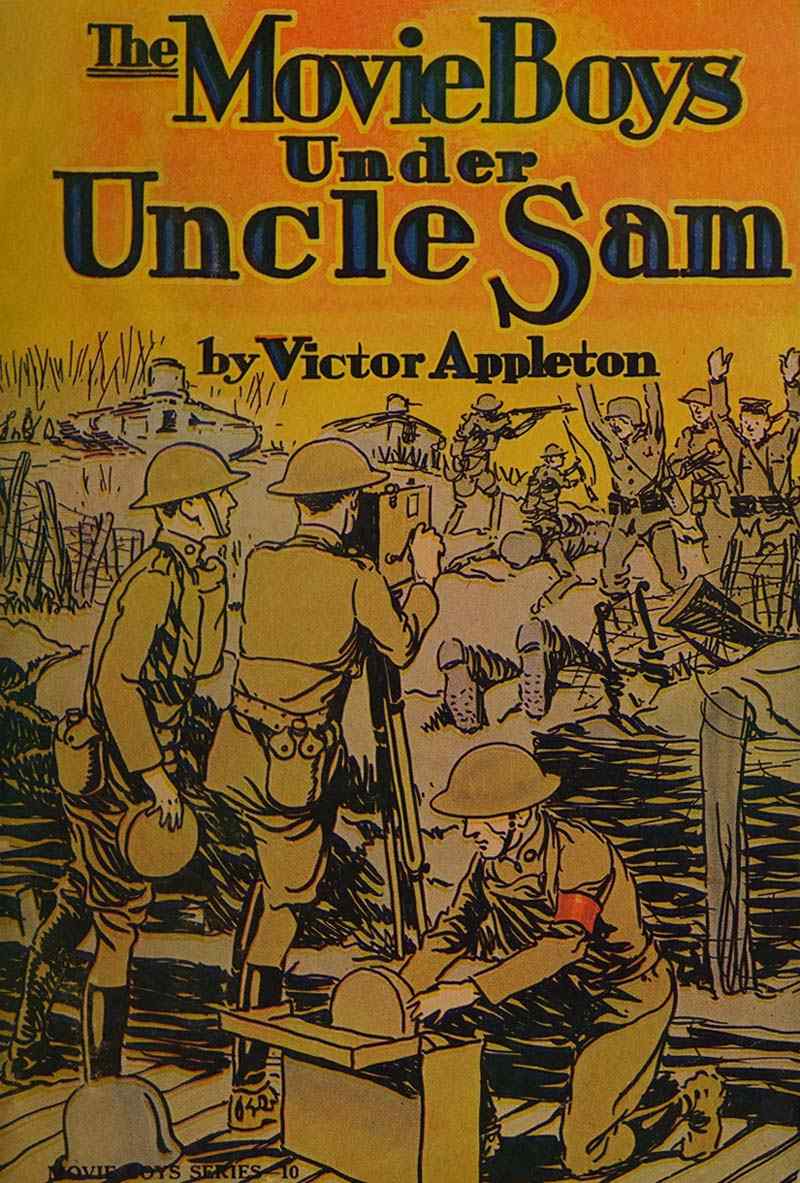
Title: The movie boys under Uncle Sam
or, Taking pictures for the army
Author: Victor Appleton
Release date: November 8, 2025 [eBook #77191]
Language: English
Original publication: Garden City: Garden City Publishing Company, Inc, 1919
Other information and formats: www.gutenberg.org/ebooks/77191
Credits: Aaron Adrignola, David E. Brown, and the Online Distributed Proofreading Team at https://www.pgdp.net (This file was produced from images generously made available by The Internet Archive)
OR
Taking Pictures for the Army
BY
VICTOR APPLETON
Author of “The Movie Boys in the Jungle,” “The
Movie Boys Under Fire,” “The Movie
Boys and the Flood,” etc.

Garden City New York
GARDEN CITY PUBLISHING COMPANY, Inc.
1926
THE FAMOUS MOVIE BOYS
SERIES
BY
VICTOR APPLETON
See back of book for list of titles
COPYRIGHT, 1919, 1926, BY
GARDEN CITY PUBLISHING COMPANY, INC.
| CHAPTER | PAGE | |
| I | DANGEROUS WORK | 1 |
| II | TO THE RESCUE | 10 |
| III | A NARROW ESCAPE | 23 |
| IV | DECEIVING THE ENEMY | 33 |
| V | CHEATING THE EYE | 41 |
| VI | DEATH FROM THE SKY | 52 |
| VII | CHARGING WITH THE TANKS | 61 |
| VIII | A CLOSE CALL | 70 |
| IX | AN EXCITING STRUGGLE | 79 |
| X | CHRISTOPHER CUTLER PIPER TURNS UP | 86 |
| XI | THE STORM BREAKS | 95 |
| XII | THE LOST FILMS | 103 |
| XIII | A TEST OF PLUCK | 112 |
| XIV | SURPRISING THE ENEMY | 118 |
| XV | A NIGHT OF JOLLITY | 126 |
| XVI | THE TRAIL OF THE HUN | 136 |
| XVII | WRECK AND RUIN | 144 |
| XVIII | SWEEPING THROUGH THE SKY | 152 |
| XIX | THE FALLING PLANE | 158 |
| XX | SURROUNDED BY FOES | 168 |
| XXI | PRISONERS OF THE HUNS | 175 |
| XXII | THE STRUGGLE IN THE CAPTAIN’S ROOM | 181 |
| XXIII | A PERILOUS SITUATION | 193 |
| XXIV | PUTTING IT OVER | 200 |
| XXV | THE LOST FILMS—CONCLUSION | 205 |
THE MOVIE BOYS
UNDER UNCLE SAM
“This sure is hot work!” exclaimed Blake Stewart, as he rose to his feet and brushed off his clothes.
“That’s what,” agreed his friend and partner, Joe Duncan, who likewise had thrown himself to the ground when a shell had landed and burst within a few yards of him. “I’ve barked my shins so often that I’ll have a case of housemaid’s knee if this keeps up.”
“My eardrums got a dose when that last shell exploded,” remarked their lanky understudy and assistant, Charlie Anderson. “But we’re still alive and kicking and that’s something.”
“Especially kicking,” grinned Blake, as he turned once more to the faithful camera with which the group were taking moving pictures of a German bombardment. “Lucky that some of that shrapnel didn’t smash this.”
[2]“It might be good dope to get into a little safer position,” suggested Joe. “Those Huns are switching their fire over this way, and we’ve had more shells drop around here in the last five minutes than we had before all the morning. Let’s shift to that shell hole over to the left.”
Blake cast an eye in the direction indicated.
“It might be a little safer,” he admitted, “but I’m afraid that part of the action would be shut off by that clump of trees. Better stick it out here a little while longer. We haven’t had such a chance for a long time and I hate to lose it.”
“All right,” agreed Joe cheerfully, for, like his partner, he was game, and would have gone through fire and water to get a good picture.
“A fellow ought to have as many lives as a cat when he sets put to do this kind of work,” grumbled Charlie.
“Quit your grouching,” laughed Blake. “You know you wouldn’t miss this for a farm. Think of the sensation this picture will make when it’s shown. Some day you’ll be sitting in a darkened theater seeing this thing unreeled, and you’ll pat yourself on the back and say proudly: ‘I helped to take that picture.’”
“Maybe,” assented Charlie grudgingly. “And then again when these are shown, I may be lying in a nice little box six feet under ground.”
[3]“Well, you’ll be over all your troubles then,” Blake was beginning to say, when Joe Duncan interrupted.
“Look at that!” he cried excitedly. “I could see the shell leaving the gun that time!”
“Easy there,” returned Blake. “Your eyesight isn’t quite as good as all that, Joe. What you saw was the bunch of wadding that followed the shell. The film got it anyway, and it looks enough like a shell to make most people believe it is one. But we’ll put the right caption on it, for there isn’t going to be any fake in this series of films. It’s going to be the real thing.”
“Right you are,” agreed Joe. “We sure don’t need any faking in pictures like these. All the reels have to do is to tell the story just as it is, and they’ll make a tremendous hit.”
It was a hot day in early September, and the position of the sun indicated that it was almost noon. Ordinarily the boys would have had some shelter from the fierce rays that beat down upon them, for they were standing just within the edge of what nature had meant to be a forest, and at this early stage of autumn the trees would have been in full foliage.
But it was a forest no longer. Shot and shell had ploughed through it until every vestige of twig and leaf had been torn away. Even the bark had [4]been stripped from the trunks, and the trees stood there in ghastly whiteness, like so many ghosts watching over a valley of the dead.
And there were plenty of dead to watch over, for all that morning there had been fierce fighting and the ground was thickly covered with motionless figures.
The American forces for some days past had been in hot pursuit of the Germans, who were making their way back to the Rhine. But that day the enemy had made a stand and put up a bitter resistance. They had taken up their position at the top of a hill, and there they had planted their artillery, which all the morning had been searching the American lines in a tremendous cannonade.
The Yankee guns had replied with a fire equally intense, and it was this spirited artillery duel that the young moving picture operators had been fixing on their films.
Suddenly there was a lull in the action and the boys looked at each other inquiringly.
“Seems to be a slowing down,” commented Joe.
“And about time,” grunted Charlie. “I didn’t know there were as many shells in the world as they’ve been firing this morning.”
“It isn’t because they’re out of ammunition, you can bet,” remarked Blake. “Not on our side, anyway. [5]Trust Uncle Sam to keep his boys well supplied. We do things in millions in this war.”
“Right you are in that!” ejaculated Charlie Anderson vehemently.
“Perhaps they’ve slowed down to cool off the guns,” suggested Joe.
“I should think they’d be red hot by this time,” Charlie observed. “And maybe those gunners aren’t doing some sweating! They’re stripped to the waist.”
“I think the real reason is that there’s something else in the wind,” said Blake. “Perhaps our boys are going to charge. They may figure out that by this time the artillery fire has beaten down the enemy’s wires so that our men can go up and clean out the trenches.”
“Good guess, old man!” cried Joe, as a long file of khaki-clad soldiers emerged from the American lines and started up the hill. “There they go now. Great! Bully boys! Oh, how I wish I were with them!”
“Now the guns are opening up again!” exclaimed Blake. “They’re laying down a barrage in front of the boys.”
It was a sight that might well have stirred the pulse of anyone not dead to all emotion. Up the hill, wave upon wave, went the American boys, over the shell-ploughed ground, clambering over [6]the trunks of fallen trees, skirting the edge of open craters, sometimes stumbling, but always advancing. Before them went a wall of fire laid down by their own gunners to screen their advance.
But now the enemy’s guns opened up again with redoubled fury. Lanes were made in the charging lines. Men threw up their hands and fell until the ground was dotted with crumpled figures. Their places were taken at once by others, and the long lines went on and on until they burst like a storm upon the enemy’s trenches at the crest of the hill.
Then there was fighting such as the boys had not yet seen in the war. The Germans, forced from their trenches, came out into the open in swarms, and their gray uniforms mingled in a terrific struggle with the khaki of the American troops. The guns stopped, as each side was afraid of firing into its own men. It became a fierce, hand-to-hand contest.
There was little rifle fire also, for the men had resorted to the bayonet, jabbing, hacking, stabbing, at times using the gun butt as well as the point. Against the sky line on the ridge the view from below was perfect, and the boys were fairly dancing with excitement as the film clicked off the story of the fight.
[7]“Our fellows will win!” cried Blake. “The Huns can’t stand before our bayonets. When it comes to hand-to-hand fighting it’s all over with Fritz.”
“That’s right,” agreed Joe. “There’s no one in the world that can stand before our boys at close quarters.”
“The Boches are bringing up reinforcements though,” said Charlie anxiously. “Look at that bunch in gray coming down on their flank.”
“But there goes a new wave of our fellows up the hill,” put in Joe excitedly. “They’ll even it up all right.”
It was not to be an easy victory, however, for the Germans fought with the fury of desperation. It was a critical point in their line of defence, and they had been ordered to hold it at any cost. Crack troops that had been held in reserve were hurried up to meet the American onslaught. But the Yankee boys’ blood was up and they were not to be denied.
For half an hour the fight continued, and then a rousing cheer ran along the American lines. The ridge was taken, the trenches were cleared, and the beaten enemy had fallen back to his second line of defense.
“Hurrah!” yelled Blake wildly. “I knew they’d do it.”
[8]“They’re the stuff!” shouted Joe. “Oh, boy, how they did put it over them!”
“And these are the greenhorns they said were going to break and run as soon as they caught sight of a Prussian uniform,” exulted Charlie.
“They run all right,” grinned Blake, “but you’ll notice they run toward the Huns instead of away from them. It’s Fritz who’s getting exercise in running toward the Rhine.”
chanted Joe.
“There go the guns again!” exclaimed Blake.
Now that the hand-to-hand fighting was over, the German artillery had again opened up, and a perfect hail of shot and shell tore over the ridge that the Americans had captured and down the slope into the further lines.
“Look there!” exclaimed Joe suddenly, as he pointed to a spot halfway up the hill.
The others looked in the direction he indicated and saw a wounded soldier trying to crawl back toward them.
“Poor fellow,” broke out Charlie sympathetically. “He seems to be pretty badly hurt, and the shells are falling all around him. But the ambulances will be along pretty soon.”
[9]“Ambulances nothing!” cried Blake. “Charlie, you stay here and take care of this film. I’m going out to bring that fellow in. What do you say, Joe? Are you game?”
“Am I?” replied Joe. “That’s my middle name. I’m with you, old man. Come along.”
A moment later, with their blood on fire, the chums were on their way up that hill of death.
It was a perilous adventure on which the moving picture boys had entered.
The German fire had increased in intensity, and now was sweeping the woods with a perfect hail of destruction. Great shells were exploding with thunderous roars, digging deep craters in the ground and sending their missiles of death far and wide.
The boys knew that they were taking their lives in their hands by venturing over that ground, but the appeal made to them by that wounded figure was too strong for them to resist.
Moving swiftly, yet taking advantage of every shattered stump and protecting rock as they advanced, they soon reached the injured soldier.
He saw them coming, and his face lighted up with gratitude as he attempted to smile.
“Go back!” he gasped. “I guess they’ve done for me, but what’s the use of you boys getting killed?”
“That’s all right, old fellow,” answered Blake, [11]as he deftly slipped his arms around the man’s shoulders. “Here, Joe, you take his feet and we’ll try to get him into that nearest shell hole. We can give him first aid there, and every minute counts.”
Joe did as his comrade directed, and they hurried the man to a deep crater a little way down the hill. The shell that made it had heaped up the dirt in the direction of the enemy, so that the edge overhung and formed something like a shallow cave.
Under this projecting edge they laid their burden. There they were comparatively safe unless a shell should chance to drop right into the hole itself.
Blake quickly got out the surgical kit he always carried and brought forth a roll of bandage. Joe, in the meantime, had been going over the wounded man with his hands to see how badly he was hurt. A bullet had ploughed through his scalp and blood had flowed freely from the gash, but the boys, who in their various adventures had become fairly expert, recognized that this was not a serious injury. It was only when Joe felt the man’s left leg that he detected at once that it was broken.
“That’s where the Huns got me,” groaned the sufferer. “I guess I’ll go on one leg now for the rest of my life.”
“Nothing like that,” said Blake cheerfully, for to him it seemed like a simple fracture. “You’ll be [12]trotting around as well as ever in six weeks from now. Hand me some of those pieces of wood over there, Joe, and we’ll make a splint.”
The bottom of the shell hole was covered with twigs and branches which had been torn from the near-by trees by the bombardment, and they soon improvised a rough splint, creditable enough for amateurs, that held the broken bone in place. The man’s face went white during the operation.
Blake unstrapped his water bottle and washed out the ragged wound in the scalp. Then he bound it up with a surgical bandage.
“There you are,” he said briskly, when his task was finished and they had placed the patient in as comfortable a position as the narrow limits of the space permitted. “Now, just as soon as the ambulance comes down the line, we’ll get you off to the hospital and they’ll finish the job.”
“It must have been mighty tough, dragging that broken leg along,” said Joe sympathetically.
“It wasn’t any fun,” agreed the soldier. “It was all-fired good of you fellows to come after me. Another shell would likely have got me by this time if you hadn’t. But you boys were taking an awful chance. What regiment do you belong to?”
“We just don’t belong,” replied Blake with a smile. “We’re doing special work for the War Department in taking moving pictures of the fighting. [13]My friend here is named Joe Duncan. My name is Blake Stewart.”
“And mine is Tom Wentworth,” said the wounded man. “So you’re the moving picture boys,” he continued, his eyes brightening with interest. “I’ve heard about you from some of the others. They said you were as plucky as they make ’em, and I’ve found out that’s true.”
“Oh, everybody here is taking risks,” said Blake modestly. “Look at yourself, for instance. You got closer to the line of fire than we did.”
“It was pretty hot,” admitted Wentworth, “but I don’t know that it was any worse than it was at Belleau Wood and Chateau-Thierry.”
“Were you there?” asked Joe eagerly, for he always felt a special thrill when he heard the names of those places where the American troops had covered themselves with glory.
“Very much there,” replied Wentworth with a faint smile. “So much there that I thought I’d always stay there, under the ground if not on top of it.”
“That was some scrap!” exclaimed Blake enthusiastically. “Two green American regiments fighting six crack Prussian divisions and putting it all over them.”
“It was lively work,” grinned Wentworth. “I remember when we first went in. We met the [14]French coming back and their officers told ours that orders had been given to retreat. ‘Go back,’ they said, ‘the enemy’s too strong.’ Our old colonel looked at them. ‘Go back?’ he blurted out. ‘Thunder! We’ve just got here.’”
The boys laughed.
“That’s real American talk,” chuckled Blake.
“American as she is spoke,” added Joe.
“You must have got some mighty good pictures this morning,” went on Wentworth with interest, though a twinge in his broken leg contorted his features as he spoke.
“You bet we did,” answered Blake enthusiastically. “Wasn’t it great the way that bunch of doughboys went up the hill? Say, we’ll have the people holding on to the arms of their seats when they see that film in the States.”
“I knew the boys would take that crest if they could only get to the top before the shells swept them away,” said Wentworth. “When it comes to hack and stab, the Heinies aren’t in it with our boys. The cold steel makes them squeal. They’re all right in a crowd, but we’ve got their goat when it’s man to man.”
The shelling had died down somewhat while they were talking, and Joe, who had thrust his head cautiously above the edge of the crater, gave a sudden exclamation.
[15]“Hullo!” he cried. “The whole regiment’s on the move! They’re swarming out of the trenches like bees out of a hive. They must have ordered a general advance.”
“We mustn’t miss that!” exclaimed Blake. “We’ve got to go along with them. But first we’ll have to see that this man gets to the hospital.”
“Don’t bother about me,” said the wounded soldier. “You’ve done plenty for me as it is. Our ambulances will be along soon and pick me up. You boys just go along.”
“Not on your life, we won’t,” replied Blake. “The pictures can wait.”
“Here come some stretcher-bearers now,” observed Joe.
He jumped out of the hole, waving his hands to attract attention. A group of men with litters came hurriedly toward him.
“Lend a hand here, fellows!” cried Joe. “We’ve got one of the boys here with a messed-up head and a broken leg.”
It was but the work of a moment for willing hands to lift Tom Wentworth out of the hole and arrange him comfortably.
“I’ll never forget the way you boys risked your life to save mine,” he said gratefully, as the men grasped the handles of the stretcher and prepared to start off with him.
[16]“Nothing at all, old man,” answered Blake heartily.
“All in the day’s work,” smiled Joe.
“And now for a quick sneak back to the camera,” Blake remarked, when the bearers with their burden had gone. “I hope that Charlie has been right on the job. It’ll be too bad if he’s missed any of this fighting.”
“Let’s hope a bullet hasn’t keeled him over while we’ve been away,” said Joe with some anxiety.
“Nothing like that,” answered Blake, as his quick eye caught sight of their assistant.
“But he’s turning the crank with his left hand,” cried Joe in alarm. “I wonder if anything could have happened to his right.”
They broke into a run.
Charlie saw them coming and a look of relief came into his eyes.
“So you’re back again safe and sound,” he cried. “I was afraid that perhaps a shell had dropped into the hole and knocked you out.”
“We’re all right,” ejaculated Joe. “But how about yourself? Why are you working left-handed? Did you get hurt?”
For answer, Charlie held up his right hand that was smeared with blood.
“Only a scratch,” he said. “A bullet grazed the back of my hand. Didn’t break any bones, but I [17]bled like a stuck pig. Didn’t have time to bind it up or I’d have missed some of the picture, so I just kept plugging along with the good old left.”
“Give me the crank,” commanded Blake, at the same time taking it from his associate. “Joe, bind that hand up for him. Your nerve is all right, Charlie, but I’d rather lose the picture than have you neglect yourself. How about it, Joe? Is it a bad wound?”
“No, I guess not,” replied Joe, as he fixed a bandage around the injured hand while Charlie involuntarily winced. “But it must hurt a lot. Charlie will have to be a southpaw for a while, but that’s all.”
“I’m mighty glad it’s no worse,” said Blake in a tone of relief. “I’d have felt partly responsible if it were, since I skipped the job and left it to Charlie.”
“Say, it was the best thing you ever did,” broke in Charlie enthusiastically. “I caught the whole action while you were making your way toward that fellow and believe me it’s some sweet film. It’ll make the chills go up and down the people’s spines when they get a squint at it.”
“Well, now let’s be hiking along,” remarked Blake, as Joe completed his work. “The regiment’s on the move and all the rest of the fighting will be done on the other side of the hill. We’ll have a splendid view of it there, too, so get a move on.”
[18]They gathered up the camera and the tripod and hurried along in a line parallel with the advancing troops.
The long slope was dotted now with stretcher parties hunting out the wounded, in order that they might be taken to the first-aid dressing stations, which were established in bomb-proof shelters a little way back of the lines. Prisoners, too, were met coming back in swarms, sullen and dejected for the most part, though on the faces of some there was a look of relief that the ordeal of battle was over. Some of the more slightly wounded had their arms about the necks of their comrades for support as they staggered along.
Most of them seemed to be holding onto their trousers with both hands, and Joe remarked on the strangeness of this.
“There’s a reason,” grinned Blake. “One of the fellows was telling me about it last night. It seems that when they take a big raft of prisoners like this the first thing they do when they round them up is to cut their suspenders. Then they can’t run away, for their trousers would slip down and trip them up. They’re so busy holding them up that they don’t have time to think of anything else and it only takes a few men to guard them.”
“Good idea,” laughed Joe. “It takes away from their dignity, but it does the trick.”
[19]The boys soon reached the top of the hill, and as they surmounted the crest a simultaneous gasp came from all three at the sight that met their eyes.
And while they are standing there, with their eyes shining and their hearts beating like trip-hammers, it may be well for the sake of those who have not read the preceding volumes of this series to tell who the boys were, and sketch something of their lives and exploits up to the time this story opens.
Blake Stewart and Joe Duncan were bright, stalwart American youths, whose early years had been spent in the country. They were working on adjacent farms when they came in contact with a moving picture company that was staging some film scenes in the vicinity. They became fascinated with the work, for which they seemed to be peculiarly adapted, and the manager of the company, a Mr. Hadley, took a great liking to the boys and gave them a place in his organization. They were quick and ambitious and eager to learn, and it was not long before they developed into skilled operators. Their experiences in New York while they were learning the ins and outs of the business are told in the first volume of the series, entitled: “The Movie Boys on Call”; or “Filming the Perils of a Great City.”
Mr. Hadley soon learned that there was no danger so great as to daunt the boys while in pursuit of [20]a picture, and he was able to branch out in a line of work from which many of his rivals shrank because of the peril involved. The boys took pictures of the cowboys and Indians and took big risks in filming a wreck off the Pacific Coast. They had many hairbreadth escapes later on in jungle scenes with wild animals and in regions where floods and volcanoes threatened them with death from one day to the next. Few adventures were more fraught with peril than their going down with a submarine, described in the eighth volume of the series.
While they had been having these experiences, the United States had been goaded into war with Germany because of the intolerable outrages on her citizens. Blake and Joe were ardent patriots, and they eagerly accepted a proposition to visit the battlefront in France and take pictures of American war-like activities for the benefit of the government. The difficulties they met in getting into the fighting zone, their narrow escape from a submarine, the way they met and checkmated the intrigues of a German spy, are told in the volume preceding this, entitled: “The Movie Boys Under Fire”; or “The Search for the Stolen Film.”
Now with their faithful assistant, Charlie Anderson—known familiarly as “Mac,” a shortening of his nickname “Macaroni,” because of his long and lanky shape, they had reached the very forefront of [21]the American army which had started on its victorious drive against the Germans.
As the boys reached the top of the hill, they saw coming toward them a tremendous mass of gray-clad figures on the double quick. The Germans, desperate at the loss of the hill, had hurried up reinforcements and organized a fierce counter-attack in the resolve to sweep the Americans from the hill. On came the ranks, wave upon wave, from as far back as the boys could see.
“Gee whiz!” cried Joe. “It looks as though we were going to be attacked by the whole German army!”
“Quick!” exclaimed Blake. “Set up that tripod and get the machine going. We never had a chance like this, and we may never have it again. Hustle now.”
On came the ranks as relentless as fate. The American guns had been signaled, and they opened up a devastating fire that tore great holes in the close-formed lines. But they closed up at once like water in the wake of a ship and kept coming.
The camera now had been set up, and Joe was turning the crank with apparent calm, although he had never been the prey to such intense excitement.
Then, like a tidal wave, the Germans struck the American lines!
The impact was tremendous, but the Americans [22]were ready for them and the attack beat against granite.
Back and forth the lines swayed like two great anacondas in mortal combat. Men went down in heaps and the survivors fought over their bodies. The lines broke up into struggling groups where resort was had to the bayonet and gun butt. It was a battle to the death.
The boys had found a position a little to the right of the line, where they commanded a view of the greater part of the fighting, and Blake had just relieved Joe at the crank, when suddenly there was a tremendous explosion, the earth beneath them opened, and tons of earth and rock went hurtling toward the sky.
A great blackness came down on the moving picture boys like a blow and for a time they knew no more.
How long his unconsciousness lasted Blake never knew.
When at last he came to himself, there was a roaring in his ears and a shimmer of dancing green lights before his eyes. His brain was reeling and his head ached horribly.
For a few moments he lay perfectly still, trying to figure out where he was and what had happened to him. Gradually he pieced events together. First he remembered that he had been at the foot of the long slope that the Americans had stormed. Then he thought of Wentworth and the broken leg that he had helped to bandage. There his recollection stopped for a time, while his dizzy brain tried to recall the rest that tantalizingly eluded him.
“Wentworth, Wentworth,” he kept repeating to himself, fearful that if he lost that clue he could go no further.
Then it all came back to him like a flash—the [24]climb up the hill, the ranks of gray coming on to the attack, the shock when the two forces met, and then the terrific explosion that had seemed like the knell of doom and the end of the world.
He tried to rise, but felt as though a ton were resting on his legs. He felt of his arms and chest, and was relieved to find that though they were bruised and sore no bones seemed to be broken.
He raised his voice in a shout, but the sound was muffled and there was no answering echo. He tried again with the same result. Then a great fear came to him that made the sweat start from every pore of his body.
He was buried alive!
He had read of such things, heard of them, knew that they had happened. Once in a nightmare he had dreamed of it, and he remembered now the way he had struggled until he had awakened to find the blessed light streaming through the window and realized that it was only a hideous dream.
But he was not dreaming now. It was all too surely a reality. He was shut out from the light of day, from the sight of men, held as though by a vise in what might prove to be his tomb.
But it would not do to give way to gloomy imaginings. While there was life there was hope. By a mighty effort he took a grip on himself, and tried to control his dizzy brain so that he could think.
[25]How had this thing come about? Had the explosion of a monster shell dug a crater and engulfed him in the thrown-up earth? Had an ammunition dump blown up?
He turned these thoughts over in his mind, only to dismiss them as inadequate. No, it was something far more formidable than either of these that had caused that tremendous upheaval of the earth.
Could it have been a mine? This seemed more probable. The Germans might have mined the hill with the idea of blowing it up if the Americans should gain possession of it. But if this was so, why had they waited until their own men were on it, engaged in deadly struggle with the enemy? Still that might have been due to a mistake in the timing.
But from these conjectures he brought himself up with a jerk. How this had happened did not after all matter in the least. The dreadful fact was that he was somewhere under ground and face to face with death.
His hand came in contact with his water bottle and he was rejoiced to find that it was nearly full. He took a long draught and cooled his hot lips and parched throat.
Although his legs were pinioned, he was able to move his arms and body without much difficulty. Loose dirt in plenty was lying on him, but not in a solid mass. Some timbers must have arched over [26]him and protected him from being crushed. But who knew at what moment these might give way and let tons of earth and rock down upon him.
Hark! What was that? A sound, far away and faint, and yet a sound, came to him. Would it come again?
He held his breath, and his heart almost seemed to stop beating while he listened.
Again the sound came and this time it did not cease so quickly. Gradually it developed into a series of tappings that seemed to be coming nearer.
A gleam of hope shot into Blake’s tortured brain. Somebody, perhaps, was taking steps toward rescue. He knew that if Joe and Charlie were still in the land of the living they would work their hands off to get to him.
But, in the meantime, the air was getting terribly close. He breathed with more and more difficulty. His lungs were laboring and his brain, which had cleared somewhat, again began to whirl.
It could not be long, a matter of minutes at the most in that confined place, that he would be able to breathe at all.
He half twisted his body around so as to bring his face closer to the earth where what little air remained was cooler and fresher than the air above.
Would help never come? Or if it came would it come too late to do him any good?
[27]He had been close to death more than once in his adventurous career, but that had been for the most part in the open where he could fight and have a chance for his life. But to die helpless and alone in this coffin of earth where all he could do was to hope and wait was too horrible for words.
He was gasping now, opening his mouth as widely as possible to draw the vitiated air that tasted like copper into his starved lungs. There was a choking feeling in his throat. He felt that consciousness was leaving him and he fought desperately to retain it.
Then suddenly a pick was thrust through the roof of his living grave, and there came an inrush of cool, sweet air that Blake drank in with great gulps as though it were so much nectar.
He could hear a confused murmur of voices now, growing more and more distinct as the vigorous and repeated strokes of the pick enlarged the hole and light as well as air rushed in.
He thought he could distinguish Joe’s voice, but he was not sure. He tried to shout himself, but it was only after a third effort that he could force his voice to utter a sound.
Then a face appeared at the hole.
“Hello!” shouted a voice that he now knew was Joe’s. “Is anyone there? Are you there, Blake?”
“I’m here,” Blake managed to get out in little [28]more than a whisper. But Joe’s quick ear heard it.
“Glory hallelujah!” he shouted. “Charlie, come here, quick! I’ve found him.”
Then he turned again to the aperture and asked anxiously:
“Are you hurt, old man?”
“I guess not,” replied Blake. “No bones broken as far as I can find out. Can’t speak for my legs, though, for they’re pinned down by something that feels as though it weighs a ton.”
“We’ll get you out in a jiffy,” cried Joe cheerfully, and reinforced by Charlie and a number of soldiers who ran to help, the hole was soon enlarged so that Joe could drop down beside his friend. Great care was necessary to avoid dislodging rocks or timbers that might come crashing down with serious results. But at last the work was done, the weight that rested on Blake’s legs was removed, and a score of willing hands were at his service to lift him out of the hole and lay him on a stretcher that had been brought.
“Thank God that you’re alive!” exclaimed Joe with a tremble in his voice, and Charlie echoed him.
“Oh, I’m worth a dozen dead men yet,” answered Blake with a queer little smile. “I guess I won’t need this stretcher either, if you fellows will just rub these legs of mine until there’s some feeling in them.”
[29]They rubbed his legs vigorously until gradually feeling returned to them, and he was able, with their support, to rise to his feet and lean against the side of a gun.
“And now tell me about yourselves,” he said to his friends when in answer to their eager questions he had narrated his own experience.
“Oh, we had luck,” replied Joe. “We went flying into a heap of bushes and got off with only a few scratches. But the shock made us woozy for a while, and all we could do was to sit looking at each other like a pair of boobs. Then we got to hunting round for you and I tell you what, old boy, we went nearly crazy when we couldn’t see anything of you. We were like a couple of wild men. A bunch of the soldiers helped us dig and, as luck would have it, we hit upon the right place.”
“It was bully of you,” said Blake gratefully, “and you sure did come just in the nick of time. I knew you’d be moving heaven and earth to get at me if you could, but, of course, I didn’t know but what you might be in the same fix as I was. How did the whole thing happen, anyway? Was it a mine?”
“That’s what,” replied Joe. “The Heinies had mined the hill, but by some mistake on their part they didn’t set it off as soon as they meant to. The consequence was that they killed more of their own men than they did of ours, though [30]a good many of our poor fellows went West, too. But it didn’t do the Huns any good, for our boys licked them good and proper, and they’re chasing them now.”
“That’s fine and dandy!” exclaimed Blake, as he looked down the hill where he could see the Germans in disorderly retreat. “I wish they’d chase them off the map.”
“They’ll chase them back to the Rhine, anyway, before they get through,” grinned Joe, “and that’ll do pretty well for a beginning.”
“But how about the camera?” asked Blake, as his mind came back to more personal affairs.
“Pretty good,” Charlie answered. “The tripod was smashed, but the box came through all right. We found it lying near us when we were trying to get our wits back. Of course, we haven’t had time to examine it very closely, but we can do that when we develop the film. I hope that film hasn’t been hurt. I’d hate like the mischief to lose to-day’s work. It’s the best chance we’ve had yet to take a big battle at close range.”
“Well, the only way to find out is to test it,” said Blake. “Let’s get back to headquarters and put the film through its bath and see how it comes out.”
“Are you sure you’re rested enough?” asked Joe solicitously.
“Sure thing,” replied Blake. “I’m a little shaky [31]in the legs yet, but that will wear off with walking. Come along.”
They passed on through groups of officers and men who were too busy to say much, but many of whom found time for a word of congratulation to Blake on his narrow escape, for the boys were general favorites with all ranks.
They had soon reached their temporary quarters, which were in a little cottage back of the lines. It was a matter of only a few minutes for them to darken one of the rooms and arrange their developing and fixing baths.
Then they took out their film and with fingers that trembled with excitement put it in the developer.
“A little bit of ice, Charlie,” said Blake, as he tested the temperature. “This water’s been standing and it’s a little too warm.”
Charlie complied, and at the end of five or six minutes they took out the film and washed it off. Then they examined it and there was a simultaneous exclamation of pleasure and relief as the picture showed up strongly.
“It’s a dandy,” ejaculated Blake.
“A peach,” agreed Joe.
“All to the good,” added Charlie.
“Doesn’t need a bit of reducing or intensifying either,” exulted Blake. “It’s just what the doctor [32]ordered. Now we’ll give it the fixing bath, wash it off, dry it, and wind it up.”
“Well,” observed Joe with a sigh of relief, when everything was done and the precious film safely stowed away, “it’s been a pretty tough day, especially for you, Blake, but we’ve got something mighty good to show for it. The best film yet taken.”
The moving picture boys slept well that night after the tremendous strain and excitement of the day, and awoke the next morning none the worse for their adventure, except that they were feeling a certain soreness that vanished, however, as the morning progressed.
Blake found himself the object of congratulations from many of the officers and men, for the news of his close call had spread rapidly.
“You just escaped by the skin of your teeth,” observed Lieutenant Baker, a young officer with whom they had struck up a warm friendship.
“I sure did,” agreed Blake. “A few minutes more and everything would have been all up with me.”
“Well, you were lucky to escape with your life,” said the lieutenant. “That’s more than many of the poor fellows did.”
“Yes,” replied Blake regretfully, “Joe was telling [34]me that a good many of our fellows were killed by the explosion. But he said, too, that the Heinies got it a good deal worse than we did.”
“That’s true,” confirmed Baker. “It was a sort of boomerang for the Huns. They slipped their trolley some way and set the mine off a few minutes too late. This German efficiency that we hear so much about isn’t always what it’s cracked up to be.”
“It’s getting to be deficiency, I guess,” grinned Joe. “Our boys sure gave them an awful wallop yesterday.”
“We must have captured a raft of them,” exulted Blake. “When we were going up the hill yesterday, it looked as though there were hundreds of the Heinies coming back as prisoners.”
“Certainly was a bunch,” grinned Charlie.
“Yes,” replied the lieutenant with a smile of satisfaction, “we killed a good many but we captured more. They’re getting easier to take than they used to be.”
“Right you are,” chuckled Joe. “They don’t seem to like our game. I heard that one of them said the other day that the Americans were easy to kill but impossible to stop.”
“Impossible is right,” declared Baker. “We’ve got them on the run now and it’s all up with them. It’s only a matter of time before we get to that sacred [35]Rhine of theirs and then they’ll throw up their hands. If they don’t we’ll just have to finish up the job and go straight through to Berlin.”
“That’s just what I’m hoping for,” said Blake grimly. “I don’t want them to quit too soon. That would make it too easy for them. I’d like to see the war pushed on German soil. I want them to taste a little of what they’ve given to France and Belgium. I want them to hear the roar of cannon and the screaming of shells in their own cities and villages. I want to see their roads choked with refugees fleeing for their lives. Of course, we wouldn’t do to them what they’ve done to the French and Belgians. We simply couldn’t. It isn’t in our nature. We couldn’t stand up old men and little boys and shoot them down. We couldn’t kill helpless women and babies, but I would like to see some of their cities go up in flames and their villages turned into piles of rubbish.”
He stopped, almost breathless with the intensity of his feeling.
“Blake is getting eloquent this morning,” laughed Joe.
“Yes,” assented the lieutenant with a smile, “but he doesn’t put it a bit too strongly. He’s only saying what civilized people all over the world are feeling. But there isn’t a chance of anything of the kind happening. Those fellows bluster a lot, but [36]when it comes right to the pinch they’ll quit like a lot of yellow dogs. They’ll make door-mats of themselves before they’ll take a chance of having their cities and towns devastated.”
“That’s where the French and Belgians had it all over them,” broke in Joe. “All Belgium had to do to save her beautiful cities from ruin was to quit at the start. But her honor wasn’t for sale. The same with the French. They had the stuff in them to stick to the end, to fight to the last ditch. Look at them when things seemed so dark this Spring. Did they quit? Not a bit of it. You didn’t hear a whine or yelp out of them. But the Heinies will quit soon enough when they find things going against them. You mark my words and see what kind of a prophet I am.”
“I think you’re right,” said the lieutenant, “but we’ll see. The thing that counts just now is that we’re licking them to a frazzle. You were speaking of the prisoners we took yesterday, but we got a good many of their guns, too. Do you care to take a look at them? We’ve got them all parked up here back of the Second Division.”
“Sure we would,” replied Blake, and he was echoed by the others heartily.
A few minutes’ walk brought them to a field where the captured guns had been collected. They made an impressive showing. There were over [37]sixty of them, of all calibers from the lighter field-pieces to the heavier monsters of tremendous range and power.
“So these are the fellows that were barking at us yesterday,” remarked Blake with exultation in his tones.
“Mighty big bunch of them,” observed Joe.
“And look at the way they’re painted,” said Charlie.
“All the colors of the rainbow. They actually make your eyes ache when you look at them,” added Joe.
“But they make your heart glad to count them,” chuckled Blake.
“Hard to keep your eyes on ’em long enough to count ’em, though, fixed up like that,” observed Charlie Anderson.
“What’s the idea of all this gaudy stuff?” asked Joe. “We’ve been keeping the Germans so busy that I shouldn’t think they’d have much time for art.”
“That isn’t art,” said the lieutenant dryly. “That’s business. It’s camouflage.”
“Oh, that’s it!” exclaimed Blake with interest. “I knew that they camouflaged almost everything else on earth and I knew they camouflage the position of the guns, but I didn’t know they used it on the guns themselves.”
[38]“They don’t as a rule,” explained the lieutenant. “When they’re holding a position on a certain front for any length of time, they content themselves with hiding the guns so that the aviators can’t spot them, but since we’ve forced them out into the open they’ve had to camouflage the guns themselves. And it does pretty well as a makeshift, too, for it’s mighty hard to locate them, with all these spots and stripes to deceive the eye. Now, for instance, if this,” pointing to one of the big guns near him, “were perfectly black, you could stand a hundred feet off with a rifle and hit it without half trying. It would be no trick at all because it would be a plain target. But if you tried to get a bead on this gun now with all its colors, it would make your eyes water, and ten to one you wouldn’t come within several yards of it.”
“That camouflage is a great idea,” said Joe admiringly.
“Big time stuff,” agreed Blake.
“It certainly is,” acquiesced the lieutenant. “But this is nothing to some of the stunts these camouflage artists pull off. You moving picture fellows are no slouches when it comes to faking things, I’ll admit. You can make an audience think that it sees a man jump from the ground to the top of the Woolworth Building. But if you could see some of the things that our boys do in the camouflage training [39]camps it would make you sit up and take notice.”
“They’d have to be pretty good if they put anything over on us,” said Joe, coming to the defense of his profession.
“I’m from Missouri,” remarked Blake incredulously. “You’ll have to show me.”
“I’ll show you all right,” laughed Baker. “I’ll tell you what I’ll do. There’s a camouflage camp of ours only a few miles from here in a village back of the lines. We’ll be busy here for the next day or two, consolidating our positions and bringing up our artillery in preparation for another advance. If I can arrange it this afternoon, I’ll get one of the army autos and whirl you fellows over. It’s likely enough there’ll be some orders to be sent over there and I’ll ask our colonel to let me take them. Would you like to go?”
“What a question,” laughed Blake Stewart, eager for the trip.
“You don’t have to ask us twice,” grinned Joe.
“Don’t leave me behind, Lieutenant Baker,” pleaded Charlie.
“All right,” concluded the lieutenant. “It’s a go then. I think I can arrange it.”
His supposition was correct, for shortly after mess he sent an orderly to the boys asking them to come to his quarters.
[40]They complied promptly and found him sitting in an army auto waiting for them.
“Ready, eh?” he greeted them. “Pile in then and we’ll break all the speed laws between here and Hoboken.”
In a twinkling they were in beside him. He took the wheel, and the big machine at once sprang forward.
“Dandy car you’ve got there,” commented Blake, as the big machine purred along with scarcely a jar, yet so swiftly that the miles were fairly eaten up.
“It runs like a dream,” observed Joe.
“It’s a lallapalooza,” added Macaroni.
“The old girl does move along rather lively,” agreed the lieutenant with a touch of pride in his voice. “Everything that Uncle Sam sends over is mighty good stuff. There’s nothing too good for the army boys.”
“Maybe the Germans wouldn’t like to get hold of a few of these,” chuckled Blake. “I hear they’re so short of rubber now that they’ve stopped using tires, and their old machines go clanking along like so much scrap iron over the pavement.”
“They’ll be short of more things than rubber before [42]we get through with them,” remarked the lieutenant.
“Short of breath if they keep on running as they have for the last few days,” laughed Blake.
“They’ll be good Marathon runners before our boys finish the job,” grinned Joe.
“Look out for that shell hole, Lieutenant,” cautioned Mac.
“I see it,” responded the officer, as he deftly guided his car past the edge of a deep crater in the center of the road. “Lucky it’s daytime instead of night, or we might have had a spill. It’s a shame,” he added. “These roads of Northern France were among the finest in the world, but they’ll all be shot to pieces before this war is over.”
They had gone several miles when Blake remarked:
“That’s a pretty big patch of woodland we’re coming to, Lieutenant. Does the road pass right through it?”
The officer seemed to be busy with one of the clutches and apparently did not hear the question. The car kept on with unabated speed directly toward the trees.
“Something funny about those trees, don’t you think?” Joe asked curiously.
“In what way?” queried Blake.
“Why, there doesn’t seem to be a leaf stirring,” [43]replied Joe, “and yet there’s a pretty good breeze blowing down here.”
Nearer and nearer the car sped towards the woods.
“Look out, Lieutenant,” cried Mac as he reached forward to clutch the officer’s arm. “You’re going to run right into that tree.”
Baker paid no attention and a shout of alarm rose from all three as the machine made straight for a mighty oak.
Then suddenly the oak seemed to split apart, two sentries stood one on either side of where the tree had been standing, and, as though by magic, the car glided into a vast rectangular space that the boys saw at once was one of Uncle Sam’s army training camps.
They looked at each other sheepishly, while the lieutenant broke into a roar of laughter.
“Stung!” exclaimed Blake.
“One on us,” admitted Joe.
“I sure thought we were goners that time,” muttered Mac, a little shamefacedly, yet with unmistakable relief for escape from what had seemed to be imminent peril.
“You movie boys were from Missouri and wanted to be shown,” chaffed the lieutenant good-naturedly. “Well, I’ve shown you, haven’t I?”
“We acknowledge the corn,” admitted Blake with [44]a laugh. “Whoever rigged up that fake curtain was a sure enough artist.”
“He’d make a dandy bunco steerer,” grinned Joe. “He’s certainly a gay deceiver.”
“It isn’t ‘he,’ it’s ‘they,’” corrected the officer. “There’s been an army of men at work on this curtain. You see, it stretches away for nearly half a mile. If German batteries caught sight of that, they’d simply think it was a patch of woods, and no matter how closely they looked at it through their glasses they couldn’t see any one stirring and they wouldn’t waste any shells on it.”
“And you don’t even have to knock to get in here,” laughed Blake. “Those sentries seemed to spring from the ground.”
“They saw us coming,” explained the lieutenant, “and at the right moment they touched a spring and the curtain rolled back on either side.”
“It’s certainly great stuff,” commented Blake, as the moving picture boys and their assistant looked about them with interest.
“I see you’re protected from the sky, too,” observed Joe, as he looked up at great strips of canvas arranged at intervals over sections of the road.
“Yes,” replied Baker, “that’s to fool the aviators. Those strips are covered with grass so that it makes the place look just like an ordinary field. The men who are in training here carry on their [45]work under those strips of canvas so that they can’t be seen from above.”
“The aviators or somebody got that horse though,” said Charlie, as he pointed to where a horse was lying stiff and stark by the side of the road.
“Poor old brute,” murmured Joe Duncan, sympathetically.
“I should think they’d get him out of the way as soon as possible,” said Blake, sniffing the air. “It’s pretty hot weather to leave him lying around.”
As he spoke, a soldier emerged from the body of the horse, stood up to his full height of six feet or more, stretched himself, yawned, and then as he caught sight of the lieutenant came smartly at salute.
The boys hardly dared to look at Baker, who was shaking with inward laughter.
“What a bunch of come-ons we are,” groaned Blake.
“I’m going to keep my mouth shut after this,” asseverated Joe.
“And your nose, too, when you come near dead horses,” joked the lieutenant. “But come close now and let’s have a look at this defunct animal.”
The boys examined the dummy horse with some chagrin but great curiosity. It was an exact reproduction of what a dead horse would appear to be. [46]The body was swelled beyond the normal size, the head hung limp, and two of the legs extended stiffly into the air. It was made of hide stretched over a framework of bamboo.
“See how light it is,” said the officer.
Joe and Blake put their hands beneath it and lifted it easily into the air.
“That makes it easy to transport,” explained Baker. “The camouflage corps can rig up one of these in a few minutes. Then it can be slipped out at night anywhere in No Man’s Land not far from the German lines. There’s a scout inside it with a rifle and a pair of field glasses and he can find out most of what the enemy’s doing or planning to do. To the Germans it’s only one dead horse among many, and they don’t tumble to it. Get inside, Larkin,” he directed, turning to the young soldier, “and show us just how the thing is worked.”
With a grin the man obeyed, slipping into the large cavity and arranging himself comfortably upon his side.
“Now come around to this side of the horse,” said the lieutenant to the boys.
They did as directed and saw the wicked-looking muzzle of Larkin’s rifle pointed toward them through a hole in the hide.
“There he is,” said Baker with a laugh, “all ready [47]for business. As snug and comfortable as you please.”
“Pretty cramped though,” remarked Blake. “He hasn’t room enough to change his mind.”
“No,” admitted the lieutenant, “he hasn’t all the comforts of home, but still he does well enough, and that repeating rifle of his would certainly give the Huns a surprise party if they came prowling around too near. Only the other day, one of our boys in a contraption like this wiped out an entire German patrol of half a dozen men. The Heinies didn’t know where the bullets were coming from. But come along now and we’ll see some things these fakirs are doing.
“Look at that tree,” he said, after they had walked a little further. “Do you see anything strange about it?”
“I don’t know about trees,” said Blake suspiciously. “Since you fooled us when you were running into that fake oak tree back there I’ve grown distrustful.”
“Oh, this is a real tree,” laughed the lieutenant. “I give you my word for that. But look at it closely. Anyone in it?”
“Not a soul,” declared Joe promptly.
“Wouldn’t want to bet on it, would you?” asked Baker.
“I wouldn’t bet on anything in this dump,” said [48]Joe emphatically. “I wouldn’t even bet that I’m alive.”
“Well,” said the lieutenant, “there is a man there, just as big and tall a man as any of us four, and he isn’t hiding behind the trunk or any branch of it either. You’re looking at him right now and you don’t see him.”
The boys rubbed their eyes and looked more closely. It was not a thickly branched tree, the sun was streaming through it, and they were sure they could see every inch of it that was toward them. And Lieutenant Baker had assured them that the man was not on the further side of the tree.
“Well. I’ll put you out of your misery,” laughed the lieutenant. “Just fix your eyes on the trunk about two-thirds of the way up. Notice anything unusual up there?”
“Seems to me it’s a little thicker there,” pronounced Blake.
“Bulges out a bit,” observed Joe.
“Seems to me to be a little crinkly like a caterpillar,” commented Charlie.
The lieutenant gave a whistle and then the resemblance to a caterpillar became more pronounced as the whole trunk seemed to crinkle into successive waves until the foot of the tree was reached. Then with a quick motion a part of the bark seemed to [49]detach itself from the tree and to come directly toward them.
“That’s all right, Thompson,” said the officer. “Open up.”
A flap fell from the head of the figure and they saw the face of a man, rather red from exertion, but wearing a broad smile.
“A little comedy I had staged for your benefit,” laughed the lieutenant. “I’d phoned over to them that we were coming and gave them a tip to let us see what they could do in the way of tree climbing. Come a little closer, Thompson, and let’s have a look at you. Or rather, back up against the tree and show us how those stripes of yours harmonize with the bark.”
The man did as directed and they crowded around him.
It was astonishing to see how perfect was the harmony between the markings of the tree and the garb the man wore. The tree had gray and white marks, and these were duplicated perfectly in the man’s costume. At the distance of a few rods it was most difficult to detect the difference.
“We use these for sniping,” observed the lieutenant. “On a settled portion of the front we have perhaps twenty, fifty or a hundred of these men, stationed in tall trees that command almost the entire space of No Man’s Land in that particular section. [50]Even their rifles are striped in the same way so as to make no contrast against the background of the tree. The men are crack shots and they’ve saved many a Heinie the trouble of taking the long hike back to the Rhine.”
“Well,” remarked Blake, taking a long breath, “this would be no place for a man with delirium tremens.”
“I’d be a candidate for a padded cell myself if I stayed here long enough,” affirmed Joe.
“I’m going to hold tight onto my plate at chow to-night,” said Mac, “or I’ll expect to see it vanish out of my hand. I’ve lost confidence in everything. Is this solid ground I’m walking on, or is that camouflaged, too?”
“We haven’t got quite as far as that yet,” replied Lieutenant Baker with a laugh.
For the next hour the moving picture boys sauntered about the camp, finding new marvels at every step. Concrete observation posts that seemed to be mere inequalities in the ground, waving ferns and grasses from which protruded the muzzles of fourteen-inch guns, innocent-looking roadways that really were yawning pits covered lightly with rushes and sods that gave way at the slightest pressure, wooden guns, dummy tanks and a host of other cunning appliances designed to bewilder and mystify the enemy.
[51]“Well,” said Blake, when at length they had reluctantly torn themselves away and were seated once more in the army car, “I have a new respect for the art of camouflage. I didn’t dream that they’d carried it to such an extent.”
“Yes,” put in Mac, “it isn’t only the doughboys with bullets that are winning this war. The artists, too, are doing their bit in beating the Huns.”
“For my part,” said Joe, as the lieutenant threw in the clutch and the car started, “it seems to me like a page from the Arabian Nights. All we need now is a genii coming out of the neck of a bottle and the thing would be complete.”
A few nights later, Blake was aroused from sleep by an unusual commotion. Noise was common enough on that active section of the front, where the artillery seldom ceased its growling even through the night.
His first impulse was to turn over and go to sleep again, for he had had an unusually trying day. But there was something insistent, ominous, strange about this tumult that finally forced its way fully into his consciousness.
He opened his eyes and looked toward the little window of the room in the cottage where he and his friends were billeted. A red glare streamed through the pane, and he was wide awake at once.
Springing from his bed, he rushed to the window and looked out. Flames were leaping high into the air from the direction in which the Red Cross hospital lay. Great billows of smoke rose skyward, and as his eyes followed them he saw a descending [53]object which a moment later was followed by a tremendous explosion.
He rushed to where his friends lay sleeping.
“Get up, fellows,” he shouted. “Joe! Charlie! get up, quick!”
They sat up in bed, looking at him stupidly, as they rubbed their eyes.
“What’s the matter?” mumbled Joe.
Blake seized him by the shoulder and gave him a vigorous shake.
“Wake up!” he cried. “Come out of your trance! The hospital’s on fire! The Huns are raiding it!”
Both Joe and Charlie were awake enough now. They leaped out of bed and tumbled into their clothes.
“The hospital!” exclaimed Joe, as he slipped on his coat. “But that’s marked with the Red Cross and it’s lighted up at night. I don’t see how the Huns could make any mistake about that.”
Blake laughed bitterly.
“You poor innocent,” he cried. “As if that wasn’t simply an invitation to those fellows. There’s nothing sacred to that breed. But hustle now. We may be able to do something to help. And Charlie, you bring the camera along and come after us. I don’t know that we’ll have any time to take pictures, but if we do I’d like to be able to show [54]the people of the United States just what kind of people it is that they’re fighting.”
The two darted out of the room, leaving Charlie to follow, and ran as fast as they could in the direction of the hospital, about half a mile away.
A faint hope still lingered that it might be some other building. But this was dissipated, as, at a turn of the road, they came in full view of the blazing structure.
The hospital base consisted of a large number of one-story buildings, spread out over a space of several acres. Some were open-air pavilions where convalescents had their quarters, others were designed for serious cases, while those of a central group were used for surgical operations. Upon the roofs of these had been painted gigantic red crosses, plainly visible to aviators by day and still more visible at night, when brilliantly illuminated.
The night was clear, the stars were out and a mistake by aviators was absolutely impossible.
The Allies had acted on the theory that they were dealing with a civilized nation, although every month that the war progressed was teaching them how utterly they had been mistaken.
The central building, that of the surgical operations, was in flames, while some of the other buildings near by had also caught fire. It was plain at a glance that the main building was doomed.
[55]A gasp of horror went up from the boys.
“There were hundreds of poor wounded fellows in that building!” panted Joe as he ran.
“Yes,” gritted Blake through his teeth. “Oh, those beasts!” he muttered, as he shook his fist toward the sky.
The whole camp had been roused by this time and thousands had rushed to the rescue. So many there were that were eager to help that they would have gotten in each other’s way, had not the officers taken command of the situation and drawn a cordon around the place, while a sufficient force of men was detailed to do the rescue work.
The scene was heart-rending. Men without legs and arms, utterly helpless, were brought out on stretchers. Some had been actually on the operating table when the raid took place, and doctors and Red Cross nurses ran along beside them, trying to staunch the blood from their wounds that had not yet been sewn up. The bombs were still raining down, and even as the boys looked, a bomb exploded in the midst of a party of doctors and nurses, blowing them and their helpless burdens to pieces.
Joe was white to the lips and Blake was trembling with rage and pity. They wanted to rush in and help, but were prevented by the military guards.
Just then, Blake felt a touch on his arm. He [56]turned and found Charlie standing panting beside him.
“I tried to get here sooner,” Charlie gasped, as he laid down the camera and tripod, “but these things were pretty heavy and you beat me to it.”
“Quick!” said Blake. “Set it up, Charlie. If we can’t do anything else we can put on record this picture of the hideous way the Germans are carrying on war.”
“That’s right,” said a voice, and they looked up to find Lieutenant Baker close beside them.
“These flames will give you light enough,” said the lieutenant. “Get the whole thing in your film, the wounded men, the slaughtered doctors and nurses, everything.”
The tripod was hastily planted, the camera placed and the film began to register.
The American commanders were not content with merely rescuing the victims of this barbarity. Allied planes were hastily manned and winged their way upward in pursuit of the raiders. Searchlights swung great arcs across the sky, seeking out the location of the attacking planes. Anti-aircraft guns from batteries all over the camp were sending their missiles upward on the chance of disabling some of the unseen foes.
Suddenly a shout went up as one of the searchlights steadied itself on two planes engaged in combat, [57]a thousand feet or more up in the sky. They wheeled about each other, jockeying for position, turning, diving, soaring, while the whir of their motors and the crackling of their machine guns could be faintly heard from below.
For some minutes this continued, and then one of the machines gave a sudden lunge toward the earth. The searchlight held it as it came down, and the spectators scarcely ventured to breathe as they watched its descent.
When half the distance had been covered, the pilot regained some measure of control and attempted to attain a higher altitude. But the plane was too badly crippled and the attempt was useless. It came lower and lower in great sweeping spirals, and a shout went up as it was seen that it bore German markings.
The crowd scattered to give it space for landing, but the moment it touched the ground they rushed toward it. It was a German bombing machine and had carried a crew of four men. Two of these had already paid the penalty, having been killed by some of the stream of machine-gun bullets rained upon them. The commander and his observer seemed to be unwounded, but their faces whitened as the crowd rushed in upon them.
A dozen hands reached in and tore them roughly from their seats and a roar went up from the throng.
[58]“Lynch them!”
“Kill the beasts!”
“Put a bullet into them!”
“Throw them into the flames!”
“Tear them to pieces!”
It would have gone hard with them, but just at that moment a captain with a detachment of men forced himself through the crowd and took possession of the prisoners.
The crowd fell back reluctantly, still growling ominously, but they were soldiers first of all and military discipline prevailed.
Unmeasured relief came into the captives’ eyes, together with something of defiance and arrogance as they saw themselves rescued from the wrath of the throng.
The captain looked them over grimly. From head to foot and foot to head again his eyes traveled with an unutterable contempt that would have blistered anyone susceptible of shame. Even the Huns fidgeted and reddened at last as that relentless gaze bored through them.
“Why did you drop your bombs on this hospital?” asked the captain in a voice that was like chilled steel.
“I didn’t know it was a hospital,” replied the aviator in passable English, but his eyes fell as he said it.
[59]“Didn’t you see the Red Crosses marked plainly on it?” pursued his interrogator.
“No,” answered the prisoner sullenly. “Anyway,” he continued, with a flaring up of his habitual arrogance, “it had no right to be located so close to the lines.”
Again the captain’s look of biting contempt.
“I knew you were a brute,” said the captain. “Now I know that you are a liar, too. Take them to headquarters,” he directed, turning to his men. “This is a matter for the general.”
The guards closed about the prisoners and forced a way through the crowd with them. They cowered as the threats and growls of the thwarted spectators were showered upon them. But no actual violence was offered and they soon disappeared from view.
“The hounds!” growled Joe. “They ought to have a brace of bullets put through their hearts.”
“Too easy,” muttered Blake. “They ought to be made to die by inches.”
“And we treat those fellows as prisoners of war,” said Charlie bitterly. “They’re simply pirates and butchers. To bomb a hospital, killing helpless wounded men, women nurses!” he concluded savagely.
“They’re doing the same thing on the sea,” said Blake. “They take a special delight in sinking hospital [60]ships. Only the other day, a hundred and twenty-three wounded men strapped to cots were drowned. Think of the Warilda, the Llandovery Castle, the long list of them, all plainly marked and lighted so that their character couldn’t possibly be mistaken.”
“They think they’re getting away with it and that when the war is over it will all be forgotten,” said Joe, “but that’s where they make their mistake. The Allies are keeping tab on the men who order these things to be done, and when Germany is beaten to her knees they’re going to demand that these men be given up to be tried and executed if convicted. They’ll find that there’s a God in heaven yet.”
“Well, let’s hope so,” said Blake. “And if the fellows who engineered this raid are ever hung, I’d give ten years of my life to be able to give the signal.”
“What’s that you’re fooling with?” asked Blake, as he came one morning shortly afterward to where Joe and Charlie were examining with great curiosity a weapon that they had picked out from a number that had been captured from the Germans.
For answer, Joe turned it in his friend’s direction and the latter jumped hastily aside as he saw a wicked-looking muzzle threatening him.
“For the love of Pete! be careful with that thing,” Blake expostulated. “I don’t want any of that ‘didn’t know it was loaded’ business in mine. What name does that murderous thing go by, anyway?”
“I don’t wonder it gives you a shock,” laughed Joe, as he obeyed his friend’s injunction. “It’s what they call an anti-tank gun. It’s a new thing the Heinies have conjured up to get the better of the tanks. Come and take a look at it.”
Blake did so. The weapon was after the rifle type, but very much larger and heavier, so much so [62]in fact that it was more than a man could easily handle and had to be operated on a swivel that enabled it to be turned in any direction.
“They say it can send a bullet through a tank at the distance of a mile,” explained Joe.
“I can readily believe it,” answered Blake. “Gee, it’s more like a piece of artillery than a rifle.”
“I’d hate to be standing in front of the muzzle when it was fired,” observed Macaroni.
“The result would be something like that the darky spoke of when he was looking at the death chair in a State prison in company with a friend,” laughed Blake. “The friend looked at the chair and said:
“‘Am dat where de prisoner sits?’
“‘It sho’ am,’ replied the other.
“‘An’ den de sheriff turns on de ’lectricity?’
“‘Yes.’
“‘An’ what happens den?’
“‘Ruin,’ replied the other, ‘jess ruin.’”
The boys laughed.
“The tanks have sure got the Germans’ goat,” remarked Blake. “Ever since the English started using them, the Heinies have been figuring up some way to stop them. First they got up some tanks of their own, but they were so big and unwieldy that they didn’t do any good. The British tanks ran circles around them. Then Fritz built solid concrete [63]pillars in all the roads where he thought the tanks would be coming along, but that didn’t bother the tanks at all. They just left the roads and meandered through the woods. If a tree was in their way it was so much the worse for the tree. The tanks didn’t mind a little thing like that. Oh, I tell you, they’re great stuff.”
“I don’t wonder the Heinies ran like sheep when they first saw them used,” commented Charlie, “and I don’t blame them much either. To be wakened out of your sleep and run out of your tent and then to see those great monsters coming at you through the mists would be enough to make any man beat it while the going was good.”
“The old car of Juggernaut wasn’t in it with the tanks,” observed Joe.
“By the way,” said Blake, “I think we’ll have a chance to see the tanks in action very soon and get some great pictures, too.”
“What makes you think so?” asked Joe eagerly.
“Well,” said Blake, “you must have noticed what a lot of them are gathering on this part of the front. For the last few days I’ve been seeing them wherever I looked. Then, too, the fellows in charge of them have been working like beavers getting them in shape. And only yesterday I heard some officers talking about the strong entrenchments the Germans have been building back of the present lines. So, [64]taking everything together, I have a hunch that they’re getting ready to send the tanks in advance to clear a way for the artillery.”
“There’s a big Jumbo of a tank in that little side road,” suggested Joe. “Let’s walk down that way and take a look at it.”
His friends were perfectly willing, and they were soon standing beside one of the gray monsters that was having some slight repairs done to it by one of its crew. He was a bright, merry-eyed fellow and was perfectly willing to talk about his gigantic pet, in which he evidently took great pride. He showed them the machine guns mounted on all four sides of the tank in addition to one three-inch field-piece.
“Regular cave you have in there,” remarked Blake, as he looked into the yawning interior. “How big a crew do you carry?”
“From six to eight men besides the operator,” replied the man. “Sometimes we have as many as ten. We lost three men the last time we went out,” he added with a shade of sadness in his tone. “But the Heinies lost a good many more,” he added, brightening up.
“What are those birds you have in that cage?” asked Blake, pointing to a wicker cage where, in the dim light in the interior of the tank, he saw some feathered creatures.
[65]“Carrier pigeons,” answered the man.
“Carrier pigeons!” echoed Joe in surprise. “What use do you find for them in a tank?”
“Lots,” was the answer. “Once in a while we get stuck in the mire or in a trench and at times we get upset. Then we’ve got to have other tanks come to help us out of the fix. Perhaps the Boches are all around us and we’d sure get potted if one of us stepped out. In such a case, we send one of the birds with a message to headquarters and help is sent in a jiffy.”
“Great stuff,” said Joe. “But what are you doing with those white mice in that basket? What is this, anyway, a menagerie?”
The tank man laughed, as he picked one of the tiny creatures up and smoothed it.
“They’re for the gas,” he explained. “You see when a gas attack is loosed the gas comes on so gradually that humans wouldn’t notice it until it was too late. But the mice detect it instantly and begin to squeal. Then we put on our masks in a hurry and throw a covering over the basket that protects the mice.”
“So even mice are in the war,” observed Blake, with a laugh.
“Very much in it,” was the smiling reply. “They use them, too, in submarines. The air in there is very close and some of the chemicals are deadly. [66]If one of the pipes springs a leak, the mice give warning and the crew gets busy right away.”
“Well,” said Joe, “I’m learning a lot about this war that I never knew before.”
“We were just saying a little while ago that it looked as though the tanks were going into action soon,” remarked Blake. “What about it?”
The man looked mysterious.
“It’s against orders for me to say anything,” he replied, “but I shouldn’t be surprised if there would be something doing before long. You said you were taking moving pictures, didn’t you?”
“Yes,” said Blake.
“Well then, you just get your films ready and stick around,” advised their new acquaintance.
Two days later, Blake and Joe were summoned to the quarters of their commanding officer.
“There’s going to be an advance by our troops to-morrow morning,” he announced. “The tanks are going ahead of them, and as you haven’t had much chance to see them in action it may be a good opportunity to get some pictures of them for the War Department. You can make arrangements to be up in the front and close beside them. It will be ticklish and dangerous work, but I’ve learned by this time that that doesn’t worry you much.”
“We’ve been pretty lucky so far, sir,” answered Blake, “and I guess our luck will hold.”
[67]The next morning before dawn, they had been assigned their place up in the front ranks. Through the gloom they could see a multitude of dark shapes lined up at intervals that they knew were the tanks. Silence reigned in the ranks of the men who were standing in their trenches awaiting the command to go over the top, for it was hoped that the attack would take the enemy by surprise.
Slowly the darkness grew less dense as the dawn crept up the sky. Then, at a given signal, the artillery opened up with a tremendous roar that shook the earth, a barrage of fire was laid down and the ponderous tanks plunged forward. On they went, followed by the men who scrambled out of the trenches. On, still on, gathering momentum as they went, until with a terrific grinding and crashing they struck the barbed-wire entanglements of the enemy.
They crumpled them up as though they were so much thread, and through the gaps they made the soldiers poured like a flood. Men fell by the score, for the enemy was replying now, and a storm of shot and shell tore its way through the American ranks. But they closed up at once and like a tidal wave swept forward.
It was light enough now for the moving picture boys to get fairly good pictures, though they knew that they would have to intensify them later on. [68]But it was getting brighter every minute and they worked away feverishly. They had had a good view of that first great onset of the tanks crashing through, but after that the infantry had got in the way and the tanks were lost sight of. But they knew that the breaking through was only the first step in the activities of the tanks, and they were desperately anxious to see them in the actual fighting.
“Come along, fellows,” said Blake. “Let’s follow them up. We’ve had plenty of pictures of infantry actions, but to-day it’s the tanks we want to see. Let’s get a move on.”
They picked up the camera and tripod and followed in the wake of the charging troops. They stumbled over dead bodies and skirted the edge of shell holes, while bullets whistled past them and shells exploded so near them as to cover them with dirt. But they were so on fire with excitement that they paid no attention to these messengers of wounds and death, and in a little while had worked their way through the lines to a point where they could once more have the tanks in full view.
“Look at them spitting fire!” exclaimed Joe breathlessly, as they dropped into a shell hole that offered them some slight measure of protection and set up their camera so that it just peered above the edge of the crater.
[69]The tanks were dashing here, there and everywhere, scattering enemy groups, smashing pill boxes, straddling trenches, which they raked throughout their length with a withering fire from their machine guns, charging batteries whose crews scattered in consternation as the monsters bore down upon the guns.
“Quick!” panted Blake in mad excitement, as with trembling fingers they started the film to registering. “Don’t let’s lose a bit of this. It’s the greatest chance of our lives. It will make the finest film we’ve yet secured.”
Like two gigantic wrestlers locked together, the two armies swayed from side to side, fighting with the utmost desperation. The Germans were using some of their best divisions, and although the attack had taken them somewhat by surprise, they had rallied and were hurrying up dense ranks to reinforce those who had been holding the first line.
They themselves had a few tanks on this portion of the front, and these were hurried into action at once. But it soon became apparent that they could not hold their own with those that the Americans were using. In the usual German way, they had relied too much on size and they had overdone it. The tanks were monstrous but they were too unwieldy and too slow. Nor were they managed with the skill that was displayed by the Americans.
“Our fellows make theirs look like thirty cents,” said Joe, as one by one the German tanks were put out of action.
[71]“There goes one of ours though!” exclaimed Mac. “See, it’s tumbling into that trench.”
“It isn’t falling in, you boob!” exclaimed Joe. “It’s going in of its own accord. It means to clean out the trench. See, the Germans are scrambling out of it already and running like rabbits.”
“They show good judgment,” remarked Blake grimly. “Listen to the rattle of the tank’s machine guns! I have a hunch that trench is an unhealthy place for Heinies just about now.”
“Let’s creep forward and take a look at it,” said Joe. “What do you say, Blake? Are you game?”
“I don’t take a dare,” answered Blake. “Sure, I’ll go. Mac, you keep at that crank till we get back.”
Macaroni grumbled a little under his breath, but obeyed, and the moving picture boys, taking advantage of what shelter they could find, hurried toward the trench which was only a few yards away.
Through the smoke that hung like a cloud over it, they saw the tank, having fulfilled its errand, go lumbering along the bottom and commence to climb the slope of the farther side.
Right in front of it lay a wounded German officer, whom the boys could see by his uniform was a major. He saw the tank approaching him and tried to crawl out of its way, but was unable to and fell back with a groan.
[72]The boys were horror-stricken, for they expected to see him crushed to death beneath the tank. But someone in the tank had observed the wounded man and the tank suddenly stopped, the door at the side opened and two men sprang out, lifted up the wounded officer and handed him in. The door closed and the tank resumed its climb.
The boys breathed a sigh of relief.
“There’s the American of it!” exclaimed Blake. “Our boys don’t war against wounded men.”
“Yes,” agreed Joe. “Do you think a German tank commander would have done the same? Perhaps he would, but I wouldn’t bet on it.”
“I think you’re right,” said Blake. “But now let’s get back to Mac.”
They crept back and reached the crater in comparative safety, much to the relief of Charlie, who had faithfully kept the crank turning, whenever a worth-while scene was enacted. And it had not been the easiest matter in the world, for it had to be turned at just a certain rate of speed and Mac was boiling like the others with the excitement of the fighting.
The battle in that part of the field was now nearly over. The first lines had been captured by the Americans and the enemy was retreating to his second-line positions. He was doing it sullenly [73]and making occasional stands to delay the Americans until reinforcements could come up.
“I think we’d better get on further ahead,” judged Blake, as the tide of battle receded. “We want to keep in touch with the hottest parts of the action and things are quieting down right here. Take the camera, Mac, and give me the tripod and we’ll go along. This battle is making history and I don’t want to miss a bit of it.”
There was no demur from his comrades and they hastily got their machine in hand and hurried on after the tanks.
Soon they had caught up with some of them and saw that they were preparing for another dash ahead. They saw the reason for it, too, in a new division that the Germans had thrown into the fight and which was advancing in close ranks for a counter-attack.
But the Americans did not await the shock of their onset. Their blood was up and they started forward to meet the advancing enemy.
“There’s a beautiful scrap coming or I miss my guess,” said Blake, as they hastily set up the camera. “Those Germans haven’t learned their lesson yet and they’re coming after more. They’re gluttons for punishment.”
“They’ll get all the fight they’re looking for,” [74]said Joe. “Get a focus on the tanks, Mac. There they go now.”
“They seem to be on fire!” exclaimed Mac in sudden alarm. “Look at the smoke coming from them.”
“Fire nothing!” snorted Blake. “They’re just throwing out smoke screens. That hides our boys behind them from being seen by the enemy, and the Heinie batteries don’t know where to aim.”
Great billows of black smoke were coming from the tanks as they ploughed their way forward. It spread out behind them until the whole country seemed to be enveloped in the gloom of a forest fire. And the illusion was heightened by the tongues of flame that began now to shoot through the smoke as the machine guns of the tanks again came in action against the gray-clad host against which they were advancing.
“That means death to the Huns, and it means death to the pictures, too,” said Blake, his professional instinct coming to the fore.
“We can’t see very much through that smoke,” admitted Joe. “But it means the saving of lots of American lives, and that’s worth all the pictures in the world.”
“Right you are,” agreed Blake heartily. “Somebody was telling me the other day that since the tanks began to be used the Allies were only losing [75]one soldier where before that time they’d lost thirty-six. There’s many a bullet rattling against the sides of the tanks that would find a doughboy’s heart if the tank wasn’t there. See the way the boys are following behind the tanks! They’re like so many suits of armor.”
“Well, how about the pictures?” put in Charlie. “I might as well stop if we’re going to stay here. I’m not registering much else than smoke.”
“On we go then,” said Blake. “Come along. We’ll be in Berlin soon if we keep on the move.”
Once more they moved forward, but now on account of the smoke the going was more difficult than before. There was hardly any breeze stirring, and the smoke, instead of drifting away, hung heavy on the field. Before them they could see groups of men engaged in desperate combats, while the tanks, like great bulls, plunged here and there, their machine guns working rapidly and doing tremendous execution.
Stumbling along over the shell-torn ground, the boys sought a place where they could command a view of the action. But this was difficult, and while they were searching, the smoke suddenly lifted, and, to their amazement and consternation, they saw a whole company of Germans bearing down upon them.
There seemed no way of escape, and visions of [76]sudden death or a German prison loomed up before their startled eyes.
Blake looked about him with desperation.
“Here comes a tank!” he yelled. “Let’s run to meet it!”
They set off in its direction, while bullets from the pursuing Germans whistled about their ears. The tank was coming toward them as fast as the ponderous machine could travel, although to the boys it seemed to be crawling. But its bullets were swift, if its pace was comparatively slow, and it soon opened fire on the boys’ pursuers, who were beginning to waver as they saw the huge monster bearing down upon them.
The moving picture boys were almost breathless from running, but they just managed to get on the further side of the tank as a volley of bullets rattled against the side of it.
“Safe for the time, anyway,” gasped Blake, as he sank down on the ground, still holding in his arms the box of precious films that in all the excitement he had not forgotten to bring along.
“No, we’re not!” cried Joe. “Here comes a German aeroplane with its guns all going like mad.”
They looked in the direction he indicated, and saw a big plane swooping down toward them with sheets of flame spouting from the four guns that the newest German planes carried.
[77]“We’re goners now!” exclaimed Mac.
But just then the door in the side of the tank opened and a man leaped out, whom, though he was covered with sweat and grime, they recognized as their tank acquaintance of a few days before.
“Come in,” he cried. “Quick!”
They needed no urging. They bundled inside in a confused heap and the closing of that door was the sweetest music they had ever heard.
It was not a comfortable place. They were horribly cramped for room, for almost every foot of space was occupied by machinery or the sweating bodies of the crew, who were busy in controlling the machine and operating the guns. The rattling of bullets against the metal sides sounded like a boiler factory in full blast and the lurching of the tank made them feel seasick. But it meant life and safety and freedom, and no haven of refuge was ever more grateful.
Gradually the tumult grew less, the bullets ceased crashing against the sides and the crew itself desisted from firing. The battle was evidently over, or nearly so. Before long the tank stopped, and the door was thrown open, letting in a draught of the cool September air that had never seemed so refreshing. The boys piled out, together with the crew, and their relief and delight can be imagined as they saw friendly uniforms all around them and [78]realized that they were inside the American lines.
The boys were full of gratitude to their rescuer, but he waved off their thanks with a friendly grin.
“All in the day’s work,” he remarked, as he stepped into the tank to drive it back to his quarters. “By the way, how do you think the old girl behaved to-day?”
“Fine and dandy,” replied Blake enthusiastically.
“It saved our lives,” declared Joe.
“That aeroplane would have finished us if you hadn’t taken us in,” said Macaroni. “What became of that aeroplane, anyway?”
“I didn’t see,” was the reply. “We might have winged it ourselves if it had been flying a little lower, but as it was we couldn’t elevate our guns enough to reach it. Well, so long and good luck;” and the big tank lumbered away.
“We’ve had many a close call,” remarked Blake, after they had watched the tank out of sight, “but if you ask me, the closest of all was the one we had to-day.”
On a sunny morning a few days later, Blake and Joe were watching the maneuvers of a small fighting plane high aloft in the clear sky. The machine was one of the newest and best of the recently delivered American planes, and great things were expected of it, although the little wasp-like flyers had had small chance as yet to demonstrate their worth.
This particular machine had gone up only half an hour previously, and the boys had followed its flight with more than ordinary interest, admiring the amazing speed with which it mounted and its quick, darting movements as the pilot manipulated his levers.
“Looks as though that machine could deliver the goods,” remarked Blake critically. “I’d like to see how it would act in a brush with one of those new Boche planes.”
“You’re going to have the chance to see,” cried [80]Joe with sudden excitement. “Look, Blake! isn’t that a Boche plane sneaking out of the cloud?”
“Of course it is!” exclaimed Blake, catching his friend’s excitement. “And he’s going to attack, sure as shooting! Just look at that!” and he jumped from one foot to the other in his agitation.
As the moving picture boys strained their eyes upward in a fascinated gaze, they saw a large Fokker aeroplane emerge fully from a fleecy white cloud, in which it had evidently been lurking. It appeared to be at a higher altitude than the small American plane whose pilot was evidently still in ignorance of the peril that threatened him.
In their excitement, the boys forgot the pilot was far beyond reach of their voices, and they gesticulated frantically and shouted words of advice and warning.
But now the American seemed to have become aware of his danger, for the boys saw him take a sudden swoop and dive and then mount steadily upward, evidently trying to climb above his enemy, and thus be in a superior attacking position. Even at that distance, the boys could faintly hear the staccato voices of the machine guns of the two aeroplanes, as each one endeavored to put his adversary out of the fight.
But the American aeroplane had been especially built to outclimb any other machine in existence, [81]and it well repaid the careful thought and skill that had been expended in its make-up. Swift and straight it flew, pointing its nose almost directly upward. The German machine was also climbing at the best speed of which it was capable, but it was no match for the American. Soon the boys were convinced that the little machine had gained a superior altitude, although they knew that a person on the ground could not judge this with any degree of accuracy.
“I guess that Yankee boy is all there,” shouted Joe, his voice higher than usual. “Just look at him, Blake. He’s pointing downward now, and that means that he’s higher than the Boche and giving him a dose of machine-gun bullets. Ah-h!” he ended, and stood silent.
A thin cloud of dark smoke arose from the German aeroplane, was blown aside by the wind, and then rose again, thick and black this time and shot through with angry tongues of yellow-red flame.
“He’s afire!” breathed Blake, “and that means that he’s done for.”
Indeed, it seemed that the German must be doomed as his machine shot earthward, a mass of smoke and flame streaming out behind it. But suddenly a black speck was seen to disengage itself from the fiercely blazing machine and throw himself out and away from the doomed plane.
[82]“That’s better than burning to death, anyway,” muttered Blake. “It’s what I would do myself if I were caught that way. The poor fellow will be unconscious, anyway, by the time he touches the ground and he’ll never know what killed him.”
Even as he spoke, however, a great white cloth swelled suddenly out a few feet above the falling German’s head, and his descent lost something of its speed. He still descended rapidly, but not with the sickening rush of his former headlong flight.
“A parachute!” exclaimed Joe. “He’ll save himself after all.”
“Looks that way,” conceded Blake. “But,” he continued grimly, “while he’ll probably save his life, it’s up to us to see that he becomes a guest of Uncle Sam, even if an unwilling one. I should judge that he’ll land about a quarter of a mile from here, and we want to be Johnny-on-the-spot when he comes down.”
Joe needed no argument to convince him of the advisability of this, and the two raced off at top speed. The German was very near the ground now and they redoubled their efforts, and to such good purpose that they reached the Boche almost at the instant he struck the ground. He landed with a good deal of a bump and the boys had no trouble in making him a prisoner, as his nerve-shattering experience had taken all [83]the fight out of him. They knew enough now of German cunning to take no chances, however, and Blake quickly relieved the aviator of two heavy revolvers that hung from a stout belt about his waist.
“Now, my aviator friend, I guess that draws your stings,” remarked Blake. “And now, forward march, and we’ll see what they can do for you at headquarters.”
Meanwhile the victorious American plane had descended and now skimmed along close over their heads. It had been the intention of the airman to make a landing and personally secure his prisoner, but when he saw that the German was in competent hands he waved at them and shouted something that the boys could not make out above the roar of the motor.
They waved back at him and shouted congratulations. It was doubtful whether the aviator heard them, but he understood their meaning. He did not descend any further, but skimmed off, mounting rapidly and soon becoming a mere speck in the clear sky.
The German followed the plane with his eyes as long as it was well in sight and then shook his head dolefully.
“Ach, Himmel!” he exclaimed, and then added in broken English: “You vos too much for me,” and [84]he shrugged his shoulders and fell into step with his captors.
“You’re right we’re too much for you,” said Blake, “and it won’t be long before all your pals and your dear old Kaiser will find it out, too.”
The Boche scowled darkly but said nothing further, and the others marched on in silence, the boys’ minds still busy with the memory of that whirling, flashing duel in the clouds.
“That parachute stunt is pretty good at that, though,” conceded Joe, voicing his thoughts. “I wouldn’t have given a plugged nickel for the chances of our German friend when I saw that his plane was on fire.”
“Nor I,” agreed his friend. “But as it has given us the pleasure of his congenial company I’m glad that he had it along.”
All attempts to overcome the sullen silence of their prisoner proved fruitless, and they reached their destination without having had a further word from him.
Once at headquarters, they turned the German over to the officers in charge, at the same time giving a brief account of the battle in the air and the circumstances attending the capture.
“Yes,” said one of the officers when they had finished. “Almost all of them carry parachutes now. I’m going to send out two men to see if they can [85]recover the one this fellow had. They’re made of the finest kind of material and there may be some wrinkles about them that our people will like to study.”
He thanked the moving picture boys for the service that they had rendered and turned the prisoner over to guards who led him away.
As the boys proceeded slowly to their quarters, they went over again the details of the exciting event in which they had been glad to take part.
“If we’d only had the camera handy,” remarked Joe regretfully.
“Yes,” agreed Blake, “it’s always the biggest fish that gets away. What a crackerjack that film would have been!”
“Gee, I’m worn to a rag!” moaned Charlie, sinking to the ground during a lull in the work and mopping his brow. “When it comes to actual fighting it’s all right but this steady grind gets a fellow’s goat.”
“Oh, stop your grouching,” sang out Blake cheerfully, busying himself with the machine. “Wait till one of those playful little bombs bursts under your nose and scatters its cunning little splinters all over the place. Then you’ll have something to worry about.”
“On the contrary,” retorted Charlie, getting painfully to his feet, “it seems to me that under those circumstances nothing would ever worry me more. Hey, look here,” he added suddenly, pointing to where a small group of persons could be seen approaching. “Isn’t there something familiar about that whole party, especially the fellow in the middle?”
[87]“Middle of what?” queried Blake, still busy with his machine and somewhat impatient of the interruption.
“Oh, next week, of course,” Charlie was beginning scornfully, when Joe, who had come up behind them unnoticed, broke in with a yell.
“Well, if here isn’t the whole moving picture crowd!” he shouted joyfully. “And in their midst, the well-beloved face of our old pal, C. C. Say, this is luck!”
“Luck,” repeated Macaroni dolefully, as they went to meet their friends. “If you call meeting a wet-blanket like C. C. luck——”
“Well, for the love o’ Mike!” cried C. C. himself, catching sight of the boys. “What ill—I mean, good—wind blew you hither?”
“After that greeting we know it’s C. C.,” grinned Blake, amid a chorus of greetings and exclamations from Miss Lee, Miss Shay and other members of the moving picture company. After a moment or two more of friendly conversation, they passed on to meet Mr. Hadley, all, that is, except Christopher Cutler Piper, alias C. C., who lingered to speak to the boys.
“Going to cheer up the boys in the trenches?” Joe demanded of the gloomy comedian.
“Say,” protested Charlie, “haven’t the poor fellows enough to stand, what with liquid fire and [88]poison gas, without turning C. C. loose on them? Have a heart!”
“Even Hun kultur couldn’t think up any worse torture than that,” agreed Joe.
C. C. turned a grieved and protesting eye upon them.
“Say, that’s a fine reputation you’re giving me,” the gloomy comedian protested. “Here I come in a spirit of self-sacrifice, to offer my services to the government, only to have my best friends turn upon me like vipers in my bosom——”
“Gee, how does it feel?” asked Blake in mock awe, while even C. C. grudgingly vouchsafed a gloomy grin.
“But seriously,” added Blake, as they turned and made their way slowly toward the deserted picture machine, “what did bring you to this neck of the woods, C. C.? Last I heard of you, you were showing off to admiring crowds on Fifth Avenue.”
“Ah, but duty called,” sighed C. C., “and I left my homeland for the dangers of the trenches. You surmised correctly, Macaroni—I have come to cheer up our brave fighting men.”
“Oh, gee,” groaned Charlie Anderson, but Joe interrupted him.
“What’s your line?” he inquired with interest. “Going to do a ballet, or imitations?”
“Worse and worse and more of it,” broke in [89]Blake, irrepressibly. “Can’t you see it—old C. C. in a spirited imitation of the dying codfish? Going to let us in on it, C. C.?”
“Yes, I can just see myself,” answered Mr. Piper bitterly. “The soldiers appreciate my talents, anyway. I entertained a crowd of them at the Y. M. C. A. last night and you should have heard the applause. Why, it shook the whole building.”
“Don’t kid yourself, old man,” cried Joe airily. “That was a bomb that shook the building and as for the applause—well, I’ve heard that life in the trenches sometimes affects men that way—shell shock, you know, and such things.”
“All right,” sighed poor C. C. resignedly. “Scoff if you will—I’m used to it. Only some time when a bomb alights upon my devoted head and there’s a large amount of nothingness left where I once stood, you may be sorry. But never mind, I never expected to be appreciated.”
The comedian wandered off and then the boys lost no time in hunting up the girls who had acted so many parts in the dramas the company had filmed.
“Awfully glad to see you!” cried Blake.
“Best thing ever,” came from Joe.
“We’re glad, too,” cried the girls.
Quite a talk followed. In the midst of this Mr. [90]Hadley came rushing up in his bustling way with both hands extended in hearty greeting to the boys. They grasped his hands with hearty liking, for their relations with their employer had always been of the most cordial kind in the years they had been together.
“Well, well,” said Mr. Hadley, beaming upon them both. “I’m delighted to see you two boys again and to find that you’re safe and sound, in spite of all you’ve been through.”
“You’re no more glad than we are to see you,” replied Blake. “But this is a surprise. We hadn’t the least idea that you were coming to this side of the big pond.”
“I made up my mind in a hurry,” replied Mr. Hadley, “and when I had decided, I found that a letter wouldn’t reach you any sooner than I would get here myself. So here I am and most of the company with me. Got over without any trouble, though one time we did get a glimpse of a periscope and we had a few anxious minutes.”
“Did you get all the films we sent you?” asked Blake, with whom the thought of his profession was always present.
“Most of them,” replied the producer, “though two lots you mentioned in your letters never arrived. Guess they went down in one of the submarine sinkings.”
[91]“That’s too bad,” said Joe. “How did you like those you did get?”
“They were fine and dandy,” replied Mr. Hadley with enthusiasm. “They made a big hit with the public, and they were especially popular with the boys in the training camps. I had a letter from the War Department, and they spoke in the warmest way about them. But I mustn’t be giving you boys a swelled head or you’ll be striking me for a raise in salary,” he concluded with a laugh.
“What’s the big idea in bringing the company over?” asked Blake.
Mr. Hadley showed a slight trace of embarrassment.
“Well,” he said rather hesitatingly, “I’m a business man, but hang it all! I’ve got some red blood in my veins just as you young cubs have, and I thought it would be the least that I could do to bring over some of the stars and go through the camps giving entertainments and cheering up the boys. We’ll make a tour of the hospitals, too. You know the girls and the comedians are not only movie actors, but most of them have been on the regular stage, and they can sing and dance and give skits and imitations. They were all willing and glad to come along to do their bit.”
“That’s just bully!” cried Joe in delight.
[92]“It will do the boys more good than medicine,” added Blake.
“We’ll hope so,” said Mr. Hadley. “If it does we’ll be fully repaid. But now to business,” he continued, with a return of his usual brisk manner. “I’ve just had a talk with your captain and he tells me there’s something brewing. He’s got wind of a coming attack and he thinks it’s going to be a heavy one. It struck me that it will be a dandy chance to get some very stirring films. Are you game?”
“You bet!” they replied in unison, the gleam of anticipation in their eyes.
“You’re like the war horse that sniffs the battle from afar,” laughed their employer. “You’ve got your nerve right with you. And it will take lots of nerve. It’s one thing to stand up to a party of Boches with your bayonet in your hand, but you fellows may have to stand up to them unarmed. It’s risky work,” he said hesitatingly, “but I know you fellows won’t back out——”
“Back out!” exclaimed Joe hotly. “The only thing I want to know is why we’re wasting time standing here.”
“Yes,” added Blake eagerly, “let’s get at them.”
“All right,” said Mr. Hadley with an admiring and satisfied glance. “That’s the answer I expected to hear. Now then remember that you’re going to [93]take the best films we’ve had yet. We’ve got to get them, but what’s just as important we’ve got to keep them. Hang on to the films after you get them as though your lives depended on it. The Boches would give a lot to get hold of them, but you fellows are smart enough to double cross them. Go to it, boys, and good luck go with you.”
With a wave of the hand he left them, and the moving picture boys quickly got their equipment ready and reported to their captains who directed them to that part of the front where the fighting was likely to be hot. Then with hearts aflame they dropped into the trenches beside the grim fighting men.
These men were simply waiting,—waiting for the moment when their taut muscles would be released, when they would burst in a trained, inspired flood over the barrier of wood and dirt to meet and stop the hordes of Huns approaching them.
Past these rigid, dust-stained heroes the boys went to a vantage point from which they could take pictures of the coming battle.
Walking, stumbling, half-blinded by the smoke from bursting shells, half-deafened by the thunder of the guns, the boys hurried on to the appointed spot.
Here, their fingers trembling with excitement, faces burning, eyes glowing, the boys set up the machine [94]and made ready for the greatest moment of their lives.
Mr. Hadley had spoken truly. It was one thing to await the onslaught of the enemy, bayonet in hand, and quite another to stand there unarmed, calmly taking pictures of the fight when any moment a bursting shell might blow them into eternity.
But they had been face to face with death before and had come through alive. Their jaws set hard and they looked calmly straight ahead. If need be they could die like men.
“I wonder how long they’re going to keep up these fireworks?” Joe shouted close to Blake’s ear. “If one of those shells happens to come our way——”
“Then there’d be a few less movie operators in the world,” remarked Blake, with an assumption of coolness and indifference that he was quite far from feeling.
“I wonder how the world would get along without such experts as we are,” grinned Joe.
“Say, I bet the Huns are getting ready to charge,” interrupted Charlie. “The bombardment’s slackening up. Listen!”
Then suddenly, without warning, the deafening uproar stopped and in its place a silence so intense that the boys could hear the beating of their own hearts.
It was the silence that precedes the storm. The [96]furious bombardment had begun the work and now it was up to the infantry to finish it.
Hardly daring to breathe, the moving picture boys waited. Then fiercely across the open space, the gray flood leaped at them. On, on they came, while grim boys in khaki waited, bayonets poised, waited for the word of command that would hurl them, unleashed hounds, into the fray.
Down upon them rushed the German hordes until it seemed that human nature could stand the terrific strain no longer. Then—the tension snapped.
Up over the sides of the trench, like an avenging fate, swarmed our boys, yelling, shouting, racing, on, on to meet the helmeted figures in gray, the fighting blood of their ancestors carrying them inevitably to victory.
“Go it, you fellows, go it!” Blake was yelling, beside himself with fierce joy—all the time automatically taking pictures.
“They can’t stop you!” Joe was yelling, equally demented.
“Get to them, give it to ’em, wallop ’em!” Macaroni added, almost weeping in his excitement. “Gee, fellows, I wish somebody’d give me a bayonet. I’ve got to stick one of those fat Heinie’s—Gosh, look at ’em—they’ve got ’em on the run——”
“They’re doing it! They’re doing it!” yelled Blake. “They’re pushing them back——”
[97]“On to Berlin!” shouted Joe, madly cranking the machine. “Only a few hundred miles, boys, and only Germans to stop you. You can’t miss it——”
“Now look at them,” Blake interrupted. “The Huns are breaking——”
“They’re broke,” agreed Macaroni, ungrammatically but joyfully. “Gee, fellows, these are going to be some pictures we’re taking——”
“But we’ve got to follow ’em up,” Blake interrupted. “We can’t let them get away from us, fellows. Think of the picture——”
“But we don’t want to take any chances with the films we’ve already got,” cautioned Joe. “If we should lose them——”
“Never mind that,” answered Blake. “This is too good a chance to lose. We’ll make it a case of double or quits. We’ve started this job and let’s put it through to a finish.”
“There’s something in what Joe says, though,” put in Macaroni. “There’s no use risking what we’ve got——”
But Blake and Joe were already out in No Man’s Land and racing after the victorious army, and Macaroni had nothing to do but follow.
“Gee, I wish they’d leave well enough alone,” he grumbled as he ran.
It was no easy progress that they made over that wire-entangled, shell-tortured earth, burdened with [98]their moving picture paraphernalia, and more than once two of the boys had to stop to rescue a companion from a mud hole or extricate him from some barbed wire that had fastened upon his uniform. It was like the tugging of nameless things and shapes in a nightmare. But their blood was up and it would have taken much more than things like these to divert them from their purpose.
“Gee, those Germans went fast when they went,” muttered Joe, as they struggled on foot by foot.
“Yes, by the time we catch up to them the fun will all be over,” grumbled Macaroni. “And we’ll have collected a few hundred scratches and several pounds of mud to show for it.”
“Oh, brace up,” said Blake cheerily. “There’s no use sounding like a funeral when we ought to be hanging out the flags. Gee, just wait till Mr. Hadley sees these films. The finest ever.”
“If he ever does,” gloomed Mac.
“Say, what’ll we do to it?” queried Joe, with returning good humor. “If you don’t slip your grouch in about two minutes, Mac, we’ll put you in a shell hole and sit on you till you’re dead.”
“Gee, I’ve been sat on all my life and I’m not dead yet,” grinned Mac. “Go as far as you like.”
The boys answered this feeble attempt at a joke in kind, then Blake broke in with a sudden exclamation.
[99]“Say, fellows, it looks to me as though there were a mighty big storm on the way,” he said, glancing up at the sky a little anxiously. “Of course it doesn’t make much difference to us, but I’d like to have these films stowed away in some safe place.”
“Yes,” Joe agreed worriedly, “and we don’t seem to be any nearer our destination than when we started. I wish we could make out our position.”
“Probably been traveling in circles,” said Macaroni, relapsing into his former gloom. “Now, we’re lost and anything may happen to the films before we get back in our lines again. We seem to have got into a blind alley some way. We’ve lost touch with the rest of the bunch.”
For once the moving picture boys failed to rally him upon his gloomy misgivings, for they themselves were a little uneasy. Evidently they had gone further than they meant and in their struggles with the bad going had gotten away from the direction of the main attack.
What if they were really lost and a bad storm threatening? It would be a trying situation, and before they got through they might find that they were inside the German lines.
Blake straightened up with sudden decision.
“There’s only one thing to do now,” he said. “We’ve got to find some sort of shelter and wait [100]until the storm blows over. Then it will be comparatively easy to find our way to the Allied lines.”
“Maybe——” Mac was beginning, when Joe interrupted him.
“I felt a drop,” he cried. “Whatever we do we’ve got to do in a hurry. Forward march!”
With no real expectation of success, they rushed from place to place, looking for some sort of refuge. But the storm had fairly broken before Joe uttered a cry of triumph.
“Here’s just the place!” he yelled. “Come on in, fellows—it may not be exactly luxurious, but at least it’s dry.”
What he had found seemed to be a deserted dugout almost hidden in the foliage of the surrounding woods. It was dirty and dark and not very sweet-smelling, but to the boys it seemed a very haven of refuge.
“The storm can’t last very long,” said Blake as they settled themselves to wait with what patience they could summon. “And at least we’ve still got hold of the films.”
“I’m not so sure of that,” said Mac with increasing pessimism. “How do we know we haven’t wandered around until we’ve gotten inside the German lines? Then some Heinie comes snooping around, finds us and the films—presto! Nothingness, where once were we.”
[101]The two boys glared at the despondent Charlie.
“I say, Macaroni, old thing,” said Joe, assuming an elaborate drawl. “You might not suppose it, but you are really wearing on my nerves; you act like a second edition of old C. C.”
Blake chuckled, and in the darkness Macaroni allowed himself a feeble grin.
Outside the rain came down in torrents, a slashing, drenching, ugly rain that tested their powers of cheerfulness and made sitting still a torture.
After a rather long interval of silence, Blake broke out impatiently:
“Gee, what an ending to a great fight like that!” “It’s all my fault, too,” he grumbled. “If I hadn’t wanted to follow up the thing and dragged you fellows along, we’d be eating chow now—big, juicy mouthfuls of it——”
“Hey, cut it out, will you?” groaned Joe miserably. “It’s like burying a man up to his neck and then putting chicken pie just beyond his reach. Gee, I’ll eat those films if we don’t get out of this pretty soon. My, how it pours!”
“I’m going to take a look,” added Macaroni, rising groaningly from his cramped position. “This sort of thing can’t keep up forever.”
“It doesn’t have to,” put in Joe disconsolately. “They say it only takes four days for a man to die of starvation.”
[102]“It won’t be quite as bad as that, you know,” Blake reminded him. “I guess even Mr. Hadley wouldn’t want us to go that far for the sake of the profession. How about it?” This to Charlie as he came slowly back from the dugout entrance.
“Not a thing in sight but rain,” he answered dismally. “And I’m getting emptier and emptier by the minute. If it wasn’t so black outside I’d make a dive for it and take a chance of being potted full of holes. Anything’s better than this.”
“You’re getting worse than C. C., Macaroni,” Joe protested. “You’re taking it for granted that we have sallied within the German lines and will get our pass to Kingdom Come if we stick our noses into the open. That puts us between the old Nick and the deep, deep sea.”
“Listen!” cried Blake suddenly, springing to his feet. “What’s that?”
Somewhere, close to them, came the deafening report of a cannon. Another and another report followed, swelling to a maddening, discordant roar.
“The Germans!” cried Blake.
“A counter-attack,” gasped Mac.
“I guess,” said Joe, slowly and grimly, “there can be no doubt but what—we’re in for it!”
The moving picture boys rushed to the mouth of the dugout and peered out into the downpour. Now there was a great deal to be seen besides rain.
Smoke from enemy bullets and exploding shells curled in a sinister mist close to the ground, and now and then a star shell lit up the weird scene luridly.
There was no doubt about it. Charlie had been right. They had, indeed, wandered within the enemy lines and now—they were trapped!
Then simultaneously they remembered the precious films and turned to reënter the dugout. They would make one desperate effort to get themselves and the films back to safety——
Crash! Involuntarily they staggered back. Before their horrified eyes the dugout was caving in!
With a yell they turned and ran, out into the storm, amid the rain of bullets and exploding shells, out into the din and confusion of Pandemonium.
[104]Running, staggering, falling, on, on through an eternity of horror, pieces of shell tearing up the ground before them in jagged, uneven rents, bullets fanning their foreheads with a ghostly breeze, never knowing what instant might be their last, they made their way—on, on in the direction of the Allied lines and safety.
They had covered about half the distance when a party of Huns saw them and with shouts of delight started in pursuit.
“It’s all up, I guess,” panted poor Macaroni, almost at the end of his strength. “We might as well say—good-bye, fellows——”
“Save your breath,” Blake commanded curtly, at the same time slipping an arm through the helper’s and dragging him on. “We’re not dead yet.”
On, on, through more eternities, while their breath came shorter and shorter, hundred pound weights seemed to drag at their limbs and even their splendid courage felt the end was near.
Then came a sharp exclamation from Joe and they turned in time to catch him as he fell.
“Let me go, fellows!” he cried, his face drawn with pain. “I’m done for. Save yourselves. Hurry——”
“Don’t be a fool,” rasped Blake, gathering all his strength for one last, mighty effort and slinging Joe [105]over his shoulder. “It’s going to hurt you, old man, but it—can’t—be helped. How about it, Mac?”
“I’m all right,” panted Charlie, gallantly, finding new strength from the great emergency to fight on. “Come on,—we must be—pretty near——”
The nightmare of that struggle! Blake, staggering under his heavy burden, kept from falling again and again by Charlie’s arm—Joe, gritting his teeth to bear the agony in his leg and make no sound—the Germans coming nearer and nearer—almost upon them!
“It’s no use,” groaned Blake at last, the breath coming sobbingly through his teeth. “I—can’t—go on—Mac——”
Then suddenly Macaroni began yelling like a maniac.
“Blake—they’re coming,” he panted, hysterically. “They’re coming—the boys—in—kha-ki—— Three—cheers——”
Then, with eyes dimmed with exhaustion, Blake saw them, wave after wave of khaki-clad boys, springing from the mist like knights of deliverance. They were saved!
Then, in the great reaction that followed, one thought struck Blake like a thunderbolt. They were safe—but the films were gone!
“Well, you’ve done it now,” commented Macaroni, [106]as, two days later, they made their way to the division hospital.
“Done what?” queried Blake, coming out of a gloomy reverie, wherein the lost films were being displayed at some German headquarters amid great rejoicing.
“Why, told C. C. about Joe’s having his leg shot up,” Macaroni explained. “Now he’ll be coming to cheer poor Joe and we might just as well send up an undertaker with orders to get measurements for his casket.”
Blake laughed in spite of his despondency.
“Perhaps it was kind of thoughtless of me,” he admitted. “But if I hadn’t told him, someone else would. Say Mac,” he added, changing the subject suddenly, “we’ve got to get those films back some way.”
“I’ve heard that joke before,” responded Charlie, crossly. “We’ve got about as much chance of rounding up those films as we have of capturing the Kaiser single-handed, and you know it. Besides, they were probably ruined when the dugout caved in.”
“I suppose so,” sighed Blake. “And I suppose there’s no use crying over spilled milk, either—only——”
“Yes, I know,” Macaroni finished bitterly. “It was the best fight we’ve ever seen or are ever likely [107]to see. The light was just right—which is nothing short of a miracle—and all that sort of thing. But what’s the use of making our young lives miserable over it? Perhaps you remember the little ditty that runs something like this: ‘What can’t be cured, must be borne with’—or words to that effect?”
Blake laughed at him and felt better.
“You’re hopeless, Macaroni,” he summed up. “Anyway, I suppose when all’s said and done, we ought to consider ourselves the most fortunate fellows in the world for getting out of that scrape with whole necks and enough life left in us to make a mess of.”
“You said it,” agreed Charlie with emphasis. “Do you know what I did? Don’t laugh, because it was really a solemn occasion. The first mirror I could get hold of after reaching civilization, I used to scan my classic brow for signs of greying locks. Yes, I knew you’d laugh at me,” he added, sadly, “but such things do happen you know, and that last stretch across No Man’s Land was enough to turn your hair green.”
“And you have to hand it to Joe,” added Blake, the light of admiration in his eyes. “We know from the condition his leg was in what he must have suffered, and yet not a word out of him. I call that nerve!”
“You said it,” commented Charlie again. “I [108]guess he went through more than the two of us put together. Say,” he interrupted himself to add excitedly, “didn’t I tell you old C. C. would be right on the job? Gee, it’s lucky we came, or poor old Joe wouldn’t have a chance for his life.”
“Here come the girls, too,” Blake added, as the two pretty leading girls of the moving picture company rounded the corner. “Looks as if Joe were going to have quite a reception.”
“Gee, now I know why he got all shot up,” Macaroni commented enviously. “It would be almost worth it, having pretty ladies bringing you bouquets and weeping on your shoulder. Pardon me a moment——”
“Where are you going?” queried Blake, grabbing him.
“Leggo of me,” the assistant responded, impatiently shaking off the hand. “I’m going to find some accommodating Boche to cut me up. Want to come? Then the girls will bring us flowers too.”
“No, thanks,” grinned Blake. “I’d rather wait and let events take their course. They’ll probably have enough chances before we get through.”
“Hello boys!” greeted Miss Shay, as they came within hailing distance. “I suppose Joe’s the object of interest with you as well as with us.”
“Lucky dog,” grinned Macaroni. “Some fellows just can’t help being fortunate!”
[109]The girls laughed and Miss Lee added suddenly:
“And here comes C. C.! Goodness, perhaps we’d better not go up just now. So much attention may make poor Joe worse.”
“Please don’t leave us,” Blake implored. “We’re counting on you to help keep C. C. in order. If he starts to tell Joe about all the poor doughboys who had to lose their legs for lots less hurts than the one he’s got, why it will be your cue to jump in with a spirited description of the latest dance step. Don’t you get me?”
“Perfectly,” laughed the girl; and a moment later they all entered the hospital together.
Something about the smell of drugs and the thought of all the wounded boys who were enduring untold suffering for the sake of their country, sobered the young folks and they entered Joe’s ward in a rather serious frame of mind.
But when the nurse led them to the white cot upon which their own particular patient was lying, they made a brave effort to regain their good spirits and greet him cheerfully.
In this Joe helped them considerably. He favored them all with a cheerful grin, looking so altogether like himself in spite of all he had been through, that their hearts grew light again and they laughed and chatted with him merrily.
[110]“So you went and made a hero of yourself,” said Miss Shay, during a lull in the conversation.
“I wasn’t any hero,” Joe disclaimed with sincere modesty. “I didn’t get my leg shot up on purpose and it was Blake who did all the hard work—and Mac, too, giving him a helping hand. If it hadn’t been for them——”
“Nonsense,” broke in Blake hurriedly. “It was you that had the nerve, being lugged along like that with your leg dangling——”
“That reminds me,” C. C. broke in lugubriously, “of a fellow——”
“Oh, Joe, have you heard the latest?” Miss Shay broke in hastily, while C. C. looked astonished and the others grinned appreciatively. “They say that after the war there’s going to be a reaction, and——”
“Say, what do you call this, anyway?” interrupted C. C. in high dudgeon. “Breaking in on what a fellow is saying and never even saying ‘excuse me.’ And the rest of you grinning like Cheshire cats——”
“It’s all right, C. C.,” purred Miss Lee, stroking his coat sleeve soothingly. “We were only trying to play the good Samaritan——”
“And I,” broke in C. C. with frigid dignity, “was trying to tell about the fellow that had his leg amp——”
[111]“Say, cut it out, will you?” cried Macaroni indignantly. “Haven’t you got any sense, C. C.?”
“Oh, let him rave,” interrupted Joe good-naturedly. “The doc said my leg had been taken in time and I’d be as good as ever in a couple of weeks, so I sha’n’t worry. The only thing that is worrying me,” he added, while a shadow crossed his face, “is losing those films. It was a shame.”
“It sure was,” agreed Blake. “We’ll never get any more like them. They were the best ever!”
“Gee, they’re at it again,” sighed Macaroni. “Some way I’ll have to rescue those films—in self defense!”
“I hear we’re in for another big time.”
It was three weeks after the unfortunate affair of the lost films and the moving picture boys were beginning to recover somewhat from their disappointment, though the hope of ultimately recovering the films never for a moment left their minds.
Joe, too, owing to his splendid constitution and the fact that his injury had not been as serious as they at first supposed, had recovered in a remarkably short time and was, as he expressed it, “once more game for anything.”
“What do you mean?” asked the latter in response to Blake’s statement. “More work at the front?”
“Yes, if you want to call it work,” answered Blake happily. “I call it the biggest kind of a lark.”
“Come across, will you?” requested Joe somewhat impatiently. “You have a habit of enjoying things all by yourself. What is it this time? More battle pictures?”
[113]“Yes,” answered Blake, thoughtfully chewing a piece of long grass. “Only this time our boys are going to do the attacking. Just small raiding parties, I guess, more to get the lay of the land than anything else. Hello, whom have we here?”
The exclamation was caused by the arrival upon the scene of Mr. Christopher Cutler Piper, gloom producer and disperser, and Charlie.
“No one much,” said Joe disconsolately, in reply to Blake’s exclamation. “Gee, why does something always happen to take the joy out of life!”
“I hope you don’t mean me,” said C. C., grinning with unusual good nature. “On the contrary, I have come for the express purpose of putting more joy into your young lives. Glad to see you up and around again so soon, Joe, old man,” he added, turning to the latter. “It was more than I expected.”
“Or hoped?” added Joe, grinning.
“There you go,” C. C. was protesting, when Charlie interrupted.
“Do you know what was the main topic of conversation on the way up?” he asked wickedly.
“No. What?” they asked together while C. C. assumed an injured air.
“How disappointed C. C. was in Joe for not doing what was expected of him and kicking off in a nice orderly manner,” replied Macaroni, enjoying C. C.’s [114]discomfiture to the utmost. “He, at least, expected him to be considerate enough to lose a couple of legs.”
“What do you think I am?” C. C. demanded indignantly.
“Something pretty bad,” responded Macaroni, unabashed.
Seeing that a separate little war of its own was about to be started, Blake hastily intervened.
“See anything of Mr. Hadley?” he asked of Mr. Piper. “Said he’d be along in half an hour and after an hour he still keeps himself in the background. I wonder what’s the idea.”
“Captured by the Boches, maybe,” suggested C. C., hopefully. “I told him he’d get his some day, prying around in places he had no business to be.”
“There he is now,” said Charlie, as the manager came hurrying toward them with a worried look on his face. “Gee, now I wonder what’s up. He looks as if the war was lost.”
Mr. Hadley seemed, indeed, to be laboring under some excitement, for while he was still some distance away he made a megaphone of his hands and shouted his question at them.
“Are you fellows ready to start?” he wanted to know. “We’ve got just ten minutes to get there before the party commences.”
“Get where, before what party?” Charlie was [115]murmuring as Mr. Hadley hurried up to them. “Some day that man will start something and then he’ll die of heart failure. It would be just as easy to tell you what he’s getting at first as last.”
“Well, I suppose he makes the mistake of leaving something to your intelligence,” remarked Blake.
“What a mistake,” sighed Joe.
Before the badgered Macaroni had time to answer to either of these insults the excited Mr. Hadley was upon them and issuing orders with the rapidity of lightning.
“Got your machine fixed, Blake—all the stuff ready? That’s right. Now for some pictures to replace those others. Come on, a little speed, boys. Got your nerve with you?”
As this was his usual question before they went into action, and as the moving picture boys considered they had answered it effectively more than once, they made no reply now, only prepared to follow the leader with all the dispatch possible.
“I feel like the babes in the wood,” Charlie confided in a breathless undertone, as they hurried on toward the scene of action. “I know not where I go.”
“Doesn’t make any difference, as long as you keep going,” Blake returned cheerfully.
“Probably all end up in a hole in the ground,” [116]gloomed a voice close by and they turned in surprise to find C. C. trudging on beside them.
“Gee, you here?” exclaimed Macaroni with appalling candor. “I forgot all about you.”
“Thanks,” said C. C. bitterly. “That’s all I get for trying to be a friend in need.”
“But we’re not in need,” countered Mac airily. “When we are we’ll send you a telegram, so you can attend the funeral.”
“What’s the idea, anyway?” queried Joe with interest.
“Coming to catch a little Boche?” Blake added jocularly. “Put him in a cage and send him to some nice little French girl as a souvenir?”
“Well, say,” remarked C. C. with animation. “That may not be such a joke as it sounds, the capturing part, anyway.”
“Yes, better men than you have done it,” remarked Charlie soberly. “They say wonders never cease.”
“How are you going to do it, C. C.?” asked Joe with a grin. “Going to get a mouse trap and bait it with limburger?”
“Say, what do you think?” C. C. was beginning indignantly when Mr. Hadley paused and waited impatiently for them to come up.
“This work is something like the other,” he told them, hurriedly, “only that this time our boys are [117]going to attack. It’s up to you to catch the start and then follow it up to the grand finish. I’m expecting big results.”
“But suppose our boys get the worst of it?” Charlie suggested. “Suppose they have to retreat?”
“Then you fall back with them, of course,” said Mr. Hadley impatiently, “and take your chance with the rest. But they won’t retreat. Now, are you ready?”
“All ready,” they responded promptly and once more went forward with all caution toward the trenches.
There was no chance for light badinage now, or conversation of any sort. Silent as ghosts, the boys stole forward through the woodland.
Exactly as they had done upon that former occasion, they slipped into the trenches and took their appointed places. C. C., exhibiting unexpected courage, took up his stand beside them.
Then, in a silence that strained every nerve to the breaking point, they stood and waited.
“Better beat it while the going’s good, C. C.,” muttered Blake in an undertone. “This is apt to be a pretty frisky scrap and not much chance for a man without a gun.”
“How about yourself?” C. C. growled in return. “I don’t see much gun and powder in yours, yet you’re sticking.”
“But I don’t see your game,” Blake insisted. “We’re here for a purpose. But you—I don’t see any reason for just giving your life away.”
“I’m not giving it away,” snapped the gloomy comedian. “I’m willing to sell it though, if somebody will just give me a chance at one of those baby-killers.”
Blake looked sharply at C. C., for there was a grimness about him that he had never seen before.
But he ventured a last protest.
“Remember you’re a civilian, C. C.” he warned. “If you’re captured you’re liable to be shot according [119]to the laws of war. With us it’s different, for we’re in a regular arm of the service. Why, even our lieutenant would chase you out of here if he noticed you.”
“He’s too busy to notice,” said C. C. obstinately. “Anyway, I’m here now and I’m going to see what it’s like to go over the top with the boys. You just stick to your films and don’t waste your breath on me.”
“All right,” replied Blake, and there was a new respect in his tone that the other had never heard before.
Then it happened—the hoarse roar of the heavy guns laying down a barrage, Uncle Sam’s boys springing from the trenches and making their way through barbed wire and over yawning holes, calling to each other, urging on—ever on.
The moving picture boys hurried hard on the heels of the fighting men, determined this time to get—and keep—the pictures, or die in the attempt.
Suddenly, the headlong rush was halted. Almost at the first-line trenches the Germans had sprung out to meet the charge, and the deafening roar of hand-to-hand conflict swelled to a hideous clamor.
The boys never remembered afterward how they set up the machine and got the pictures, in fact, they were not at all sure that it had not been a hideous nightmare and they had dreamed it all.
[120]At first it seemed that the attacking party was getting the worst of it, and our boys were making ready to fall back with the rest. Then the tide suddenly turned and the Allied troops surged forward irresistibly, capturing the first-line trenches and sweeping on.
With a glad shout, Blake and Joe and Charlie picked up the machine and films and started in pursuit.
“Gee, this is the life!” cried Joe in a voice hoarse from shouting.
“You bet!” yelled Blake. “These films ought to be great.”
“If we don’t lose them,” added Macaroni pessimistically.
“Guess the Rhine’s the limit now,” Joe was exulting, when they were halted once more by a desperate counter-attack from the enemy.
Once more it seemed that the attackers must fall back beneath the fierce onslaught, but once more sheer nerve and grit carried them on and over almost insurmountable obstacles.
Step by step, inch by inch, the soldiers forced their way forward, while behind them the moving picture boys were writing down indelibly the history of achievement.
“Gee, if only somebody’d give me a gun!” screamed Macaroni, beside himself with excitement. [121]“I bet I could kill two Heinies while those fellows are killing one.”
“Where’s C. C.?” yelled Blake, close in Joe’s ear.
“Don’t know,” the other answered in the same manner. “Haven’t seen him lately. Hope the old boy hasn’t got his.”
They had not much time for conversation, for once more the boys were sweeping forward, faster and faster as the enemy lost its grip.
“Gee!” shouted Charlie, “guess maybe you knew what you were talking about, Joe, old man. It sure does look like the Rhine this time. Say, wouldn’t I like to be in on the finish!”
But the Rhine was still several hundred miles away when the victorious army was finally halted. Five miles had been covered in that brilliant dash and everyone was hilarious.
Of course, there were many who had dropped along the way, many who would never smile again, but they had died gaily, gloriously, for the cause of justice and of right. Looking on their calm, young faces, who would not rather envy than pity them?
“It’s pretty tough, just the same,” Charlie was saying soberly, as some time later the three friends made their way toward the mess kitchen to receive their very much-needed portion of food. “If a fellow’s got to die, I suppose that way’s as good as any. But—this world’s a pretty interesting place [122]after all, and I wouldn’t much mind spending my threescore and ten on board the old ship. I say, what have we here?”
His exclamation was caused by their sudden coming upon an excited group of doughboys, the cause of whose excitement they could not immediately discover.
They elbowed their way through to an inside position, however, and there, face almost purple with indignation, hands wildly gesticulating, who should they see but Christopher Cutler Piper, late comedian for the picture company.
“Jumping Jehoshaphat!” murmured Joe, in astonishment.
“Who left the door open?” added Charlie, irreverently, while Blake pointed excitedly behind C. C. to where two soldiers in ragged German uniforms stood sullenly waiting.
“So you kept your word, did you, C. C.?” shouted Blake.
C. C., who had turned with a scowl at the interruption, seeing the cause of it, broke into a broad, delighted grin.
“You bet I did!” he yelled, in answer to the question.
“Say, go on with your story, will you?” urged one of the doughboys impatiently.
“You were telling us how you found these—yellow [123]dogs,” suggested another, scowling blackly upon the sullen prisoners.
“Yes,” agreed C. C., his face once more assuming the furious purple of indignation. “I was telling you how these skunks—say, what do you suppose they were doing, fellows?” he interrupted himself to glare savagely around at his audience. “They were prowling around, sticking their bayonets—into—wounded men—some of them so near dead they couldn’t lift a—finger to—save themselves——”
A murmur of rage passed round the group and the boys made an ominous movement forward, but C. C. once more claimed their attention.
“I’d found an old broken gun,” he was saying, “and I gave one Hun a whack over the hardest part of him that made him stagger and then I wrestled with the other till I got his dirty knife away from him and—and here we are,” he finished rather lamely.
There were shouts of:
“Bully for old C. C.!”
“I should say that’s pretty good—landing two at once!”
“Keep it up, old man—maybe next time you’ll land a jolly little quartette, you know!”
C. C.’s face beamed like a huge, round moon and he looked happier than the boys had ever seen him.
As the crowd dispersed, the three chums surrounded [124]the hero of the occasion and nearly shook his hand off.
“Great work, C. C.!” cried Blake heartily. “I thought you were only kidding back there, but I’ve sure learned my mistake.”
“How about some chow, eh?” Joe suggested yearningly, when the congratulations were over.
“Yeah,” added Charlie hopefully. “Even heroes have to eat, don’t they, C. C.?”
“Shouldn’t wonder,” responded the latter, sniffing the air hungrily. “But I’ve got to dispose of these Heinies first,” this last with a disdainful glance toward the prisoners that made them scowl sullenly. “Here comes Captain Mayo now—guess I can hand them over to him.”
Captain Mayo seemed more than willing to relieve the comedian of his charges, and after a few words of real praise and a hearty grip of the hand that made Mr. Piper beam anew, the captain left them to their fate—and chow—hurrying the Germans before him, with a couple of guards.
“Get some good pictures?” queried C. C., as, with steaming plates, they settled themselves comfortably on a convenient mound of earth, a few minutes later.
“Yes, they ought to be pretty good,” Blake responded, his mouth full.
“We’re not going to lose them this time, either,” [125]Joe added, patting the box beside him affectionately. “The Heinie that gets this gets it over my dead body, as the villain would say.”
“But they can’t be as good as those others we lost,” gloomed Blake, while Charlie looked around for something to throw at him.
“Somebody’s always taking the joy out of life,” he sighed. “We can’t even forget our troubles while we’re eating.”
“Well,” said C. C., warmed to rare enthusiasm by the day’s success and the appetizing chow, “I have a hunch that those films aren’t gone for good. I bet you that before long they’ll be turning up, large as life and twice as natural.”
The boys stared and Charlie threw up his hands in dismay.
“Now I know the world is coming to an end,” he cried. “C. C. said something cheerful!”
“We ought to be able to pull off a pretty good time for the fellows to-night,” Blake remarked thoughtfully, as he and Joe, with Charlie and C. C. bringing up the rear, sauntered slowly along the deserted country road. “It’s a good idea, too, to give the fellows something to laugh at and get them as far away from the trenches as we can—for one night at least. Don’t you think so?”
“Er—what did you say?” stuttered Joe, disengaging himself with difficulty from his somewhat gloomy thoughts and looking dazedly at his friend.
“Say, what’s the matter with you these days?” Blake demanded indignantly. “I think you must be in love or something.”
“Or something is right,” chuckled Joe. “No, old man, French girls don’t hold a candle to the girls in the good old U. S. A., to my way of thinking. Better guess again. But what were you saying?” [127]he added, suddenly remembering that Blake had been saying something about something or other.
“I was just remarking,” Blake replied stiffly, “that Mr. Hadley had the right idea when he suggested comedy stuff instead of high tragedy for to-night.”
“Oh, for the picture show we’re going to give in the Y,” said Joe, waxing intelligent and interested at the same time. “Well, of course, he’s right. The boys have enough bloody stuff without having it rubbed into their amusements.”
“We are going to give them one high-class, five-reel picture though,” continued Blake, waxing warm in his enthusiasm, “with the classiest little cast going——”
“My, don’t we hate ourselves,” Joe put in with a chuckle. “It ought to make quite an effect, though,” he added, “to have the actors and actresses in the piece come out to the footlights in person and make their little speeches. It will be some surprise to find them on this side of the water.”
“Quite spectacular,” agreed Blake. “It will all be fine if only C. C. can be persuaded to postpone his famous imitation of the dying codfish——”
At this moment C. C. himself hailed them from the rear and they waited for him and Macaroni to come up.
“Say, what do you think this is?” C. C. was complaining querulously. “I started out for a gentle [128]little stroll among the lovely woodland creatures——”
“Gee, does he mean us?” chuckled Charlie, but beyond one withering glance, C. C. declined to notice the interruption.
“And instead of a mile or so, we wander miles——”
“You’re the only one who’s wandering, C. C.,” put in Joe, with a grin. “And your feet aren’t doing it either.”
“Never mind, C. C.,” Blake laughed, putting a soothing hand on the irate comedian’s arm. “Joe doesn’t mean anything by it—the heat always does that to him. We were just wondering,” he continued, with apparent sincerity and deep guile, “what kind of a speech you were going to hand the boys to-night.”
“Yes,” added Joe. “Is the dying codfish dead, C. C., or is he to be revivified for the occasion?”
“Gee, if he’s dead somebody ought to get busy and bury him,” murmured Macaroni, at which they all grinned—except C. C.
“I regret to see,” the latter declaimed pityingly, “that you are willing to waste time and breath on what you must know to be a purely imaginary object. The only time I ever saw an animal of that kind,” he continued reminiscently, “was on a fishing trip with my aged and now defunct Uncle Abner. [129]I suppose you might have called him a dying codfish——”
“Who, your Uncle Abner?” queried Joe, with disarming innocence.
“No, the fish,” C. C. explained patiently.
“Tell us about it,” said Joe and Blake together, their faces unnaturally grave.
“Well, it was on a beautiful summer day,” C. C. began thoughtfully, his eyes on the far horizon, “when my Uncle Abner suggested that I accompany him upon a fishing trip.”
“Methinks I heard something of the sort before,” murmured Macaroni, but both Joe and Blake silenced him with a look.
“I must have been about ten years old at the time,” the narrator continued thoughtfully, “and all the angling I had ever done had been by the somewhat crude method of string and bent pin.”
“Did you ever catch anything with it?” queried Charlie with real interest.
“Sometimes,” C. C. answered with a twinkle, yes, a real twinkle. “But it never did me much good because I had a little sister with a very tender heart who cried so hard whenever I happened to catch anything that I had to throw it back to keep peace in the family.”
“Gee, I’d have thrown her in after it,” murmured [130]Charlie indignantly, but again a glance from the others silenced him.
“Well, to continue,” went on C. C., looking as though he were really enjoying himself. “Uncle Abner, being an experienced fisherman, sniffed scornfully at my prehistoric tackle and offered as a great favor to lend me one of his lightest poles. Of course, I was flattered and had visions of myself telling the story of my wonderful catch——”
“Which wasn’t caught,” again murmured Mac.
“To the admiring and open-mouthed youngsters,” continued C. C. imperturbably, “who had shared my lowly fishing expeditions with the string and bent pin. Then, too, my tender-hearted little sister had been ordered to stay at home, much to my secret joy, and I knew that by the time I reached home with my marvelous catch the fish would be no longer in the land of the living, which would form a valuable argument against restoring them to their native element, as no good could result therefrom.”
“Really,” again put in Macaroni, and this time the others chuckled with him.
“Well,” continued C. C., too much interested in his story to notice the interruption, “Uncle Abner explained to me the intricate mechanism of the rod and tackle—at least, so it seemed to me then—stationed me securely upon a rock that jutted out over [131]the water and with a few last instructions, left me to my fate.”
“Yes, yes, go on,” they cried in chorus.
“Where does the dying codfish come in?” Joe added.
“I was coming to that,” Mr. Piper protested. “Give me time.”
“Cæsar had time and he conquered,” murmured Macaroni again.
“Well,” C. C. continued, “the afternoon wore on and nothing happened. Uncle Abner was one of those scientific fishermen who act as though you’d committed a crime if you wiggle your big toe. And as the sun went down, my hopes of a big catch went down with it, and, not seeing anything else to do, I went to sleep.”
“Enter the codfish,” cried Joe dramatically.
“Say,” protested C. C., this time indignant, “who’s telling this story anyway? If you think you can do it better——”
“No, no, C. C., I was only fooling,” Joe hastened to apologize. “You were saying you had just yielded to the blandishments of Morpheus, or words to that effect——”
“I was saying,” Mr. Piper corrected frigidly, “that I had just fallen asleep——”
“Oh, pardon me,” from Joe.
“When I got a nibble,” said C. C. sternly.
[132]“Well, you don’t need to look at me,” Mac protested. “I didn’t do it.”
“What happened then, C. C.?” asked Blake hastily. “You say you felt a nibble——”
“And such a nibble,” agreed C. C., warming to his story again. “Say, you may not believe me, boys, but it jerked me half off that rock.”
“Gee, what was it, a whale?” cried Joe, eyeing the comedian’s rather bulky frame unbelievingly.
“You forget,” said C. C. acidly—for C. C. loved being interrupted the way an irate bull loves a red flag—“that at the time of my story I was only ten years old and not as—er—shall we say—well-padded, as I am now. And the fish was not a whale.”
“Of course it wasn’t,” agreed Macaroni happily. “Don’t be stupid, Joe. Don’t you see? It was the dying codfish——”
“There you go, forestalling me again,” protested C. C. “A fellow has about as much chance of telling something to you fellows——”
“Yes, yes, go on,” again urged Blake. “You woke up to find yourself being jerked forcibly from your rocky perch——”
“It wasn’t a perch, it was a codfish,” Macaroni insisted, while they looked for something to throw at him.
“Go ahead, C. C.,” Joe entreated placatingly. [133]“Did you succeed in landing this er—animal—or did it land you?”
“Neither,” C. C. replied ruefully. “Uncle Abner grabbed the line and succeeded in bringing the fish to shore. It was a perch, not a codfish, and if it was dying it camouflaged the fact pretty well and, say, it was a beauty. But just as Uncle Abner gave a last turn to the reel I’ll be darned if the fish didn’t break away, hook and all, and slide down into the water again.”
“Gee, that was tough luck,” murmured Mac sympathetically. “So the dying codfish—or perch—still lived on.”
“He refused to shuffle off the mortal coil,” chanted Blake.
“But shuffled off the hook instead,” finished Joe, while even C. C. allowed himself a feeble grin.
“But say,” remarked Blake suddenly, bringing them with a start to a realization of the present. “That sun says it waxeth late and we’ll have to do some hustling if we expect to pull off that show to-night.”
Several hours later, the Y. M. C. A. tent was crowded with uniformed figures, boys with eager faces, glad to get away from the horror and nightmare of war, determined to enjoy this hour of relaxation to the utmost.
Mr. Hadley had chosen the films himself, carefully [134]cutting out everything suggestive of war and making fun the keynote of the evening.
The boys shouted with glee at the clever comedy and applauded the acting of pretty Miss Lee and Miss Shay in their stirring, five-reel drama, with boyish enthusiasm.
“Say, don’t those girls make you think of home?” asked one doughboy of another, his eyes shining with something deeper than admiration. “Birdie Lee reminds me of a little girl, say Frank—I wish you could see that little girl. She’s——” his voice broke and the other boy stretched a hand across his shoulders.
“I know, old man,” he said, in a husky whisper. “I’ve got one like that, too. And that mother—gosh, man, I can’t get over feeling that I’ve seen my mother—there on the screen——”
And then before the astonished and delighted eyes of those young soldiers the actual actors in the play appeared—the girls who had reminded them of their sweethearts, the mother who had seemed their mother——
There was an incredulous murmur that swelled into a roar of delight, and the boys cheered and clapped and whistled till the place was a very pandemonium of sound.
It was a long, long time before enough order had been restored to make speeches possible, and then [135]applause often drowned the voices of the speaker while he or she waited, smiling, but with a queer little tightening of the throat until comparative quiet reigned again.
Those boys—their bravery, their gallantry, their enthusiasm!
At last it was over and the two soldier boys who had spoken before sauntered out with the rest, arm in arm.
“Going to turn in, Frank?” asked one.
“Soon, I guess,” the other answered. “But I’m going to write—first. Say, old man—that little woman on the screen with the white hair and the—the—homey look—I suppose I’m crazy, but I can’t get over the idea that I’ve seen—my mother——”
“I hear we’re in for a new kind of a trip, fellows,” said Blake, hurrying up to his friends one morning a few days later.
“Nothing that will take us away from the fighting line, I hope,” returned Joe.
“Not very far away,” answered Blake, “and not for a long time. I got the tip from C. C. It seems that the War Department cabled or wirelessed to the authorities here that they want a special set of films and they think that we’re the fellows to do the job. C. C. was present when Mr. Hadley got the message and he said—But here comes Mr. Hadley himself and it’s dollars to doughnuts that that’s what he wants to talk to us about.”
Mr. Hadley came up to them in his brisk way and, as usual with him, plunged right into the subject without beating around the bush.
“Got a different job for you, boys,” he said. “I want or rather Uncle Sam wants a set of pictures of [137]the devastated parts of Northern France. You see, it’s this way; Germany is going to be licked good and proper, and not very long from now either. She’s on her last legs, although she keeps putting up a pretty stiff bluff. But we’ve got her going and she may crumple up any time like a bit of paper——”
“Scrap of paper,” interjected Joe with a twinkle.
“Scrap of paper is right,” resumed Mr. Hadley with a smile at the allusion. “Now when that breakdown comes and she throws up her hands, the Allies will have to frame a treaty of peace, and the first thing they’ll have to do is to figure up the damages that Germany will have to pay for all the evil she has done.”
“I hope they soak her good and plenty,” said Joe, with a stern crease in his brow.
“They’ll do that all right,” said Mr. Hadley confidently. “But they want to have an actual record in pictures of what she’s really done to the towns and villages her troops have occupied or passed through. Of course, you can’t get it all, but you can get enough to shut the mouth of the stupid and the pro-Germans who claim that these things have been exaggerated, that Germany isn’t as black as she has been painted and therefore ought to be let down easy and so get out of her just punishment. Do you get me?”
[138]“Sure thing,” replied Blake. “The only trouble is that we’re too late to get the worst things she’s done. We can’t get the pictures of the little boys and old men that she lined up against the wall in Dinant and shot down in batches. We can’t get the women and babies who have been stabbed and bayoneted and burned to death. We can’t get the helpless passengers in small boats that have been shelled by submarines, the men and women drowning in icy waters while the Huns stood on their decks and laughed at their dying agonies. We can’t get the thousands of young girls torn from their mothers’ arms in Lille and other cities and sent into Germany to toil for their conquerors. And if we did get them they’d be too horrible to show. The heart of the world would break in looking at them.”
His voice trembled with the vehemence of his emotion and his fists were clenched so that the nails bit into the palms.
“Yes,” said Mr. Hadley soberly, “you’re right, Blake. We can’t make Germany give back the innocent lives she’s taken and the punishment for that must be left to God. But we can make her pay for the material damage she has done up to the limit of her ability, and it is for that reason that we want this series of films. They’ll be part of the evidence. What do you say? I laid the matter before your commander and he said that, of course, if the Department [139]wanted it, it would be all right. You’ll have a big army automobile for yourselves and another one will carry supplies and a couple of soldiers who will go with you as an escort.”
“Sure we’ll go,” replied Blake.
“You bet we will,” echoed Joe.
“Count me in,” said Charlie.
Mr. Hadley looked his gratification at their readiness.
“I warn you it will be a depressing trip,” he said. “It will be anything but a joy ride. It will be like riding through a cemetery. It was Attila, wasn’t it, who said that the grass never grew where his horse’s foot had trod? Well, Attila was a Hun. Do you get me?”
“We get you,” they answered in unison.
“When are we slated to start, Mr. Hadley?” asked Blake.
“To-morrow I guess, or next day at latest,” answered Mr. Hadley. “We’ll get the autos tuned up to-day so that they’ll be in shape for the trip, and we’ll see that there’s plenty of all kinds of grub, for you probably won’t be able to get any on the way for love or money. Most of the people in the sections you go through will be half starved and the rest will be living on charity. The Allied armies are sending them supplies as fast as possible, but it takes time. Get a hustle on now, boys. I’ll see that [140]you’re supplied with films enough to last you for the trip.”
He hurried away and the boys set to work at once to make ready. They reported to their commander and got his formal permission for the journey. Two men were assigned to them as an escort, clean cut, likely looking fellows, and to their surprise and pleasure they noted that one of them was Tom Wentworth.
“Why, how are you, Tom?” Blake greeted him heartily. “So you pulled through all right, did you? It’s good to see you around again with two good legs.”
“The sawbones didn’t take your leg off, eh?” queried Joe with a grin.
“No,” replied Tom with a smile. “I saved the old peg, thanks to you fellows. The doctor said that if you hadn’t made such a good job of that first aid I might have had to lose it. I can never thank you boys enough for the way you risked your lives to save mine that day.”
“Oh, it’s all right,” said Blake. “Both Joe and I are only too glad that we happened to be Johnnies-on-the-spot.”
“I hear you got a dose of trouble of your own that same day,” remarked Tom.
“Yes,” laughed Blake, “I got buried in the mine explosion and came near passing in my checks. But [141]a miss is as good as a mile and I got through all right.”
The next morning bright and early, they started off. In the first car were Blake, Joe and Macaroni, with an army chauffeur, while Tom and his comrade followed in the second car, or rather a combination of car and motor truck, that carried all the supplies they were likely to need on the journey.
All the members of the moving picture company were on hand to see them off, although it was an unusually early hour.
C. C. was there with the rest, and his face was, if possible, even more lugubrious than usual.
“Remember that there’s a whole lot of mines and shells there that haven’t been exploded yet,” he cautioned. “I shouldn’t be surprised if one of them would get the whole lot of you.”
“They haven’t got us yet, and we’ve been in a good many more risky places,” laughed Joe.
“That’s just it,” persisted C. C. “You’re just about due for it. The pitcher that goes to the well too often gets broken at last.”
“For goodness’ sake,” put in Nellie Shay. “Any one would think, C. C., that we’d gathered to attend the boys’ funeral. You’re as cheerful as a crutch.”
“I move that C. C. be sent to talk to the German prisoners,” said Birdie Lee mischievously. “After they’ve listened to him for a while they’ll all commit [142]suicide, and then the government won’t be at the expense of feeding them.”
They all laughed, while C. C. looked at her reproachfully.
“Cheer up, C. C.,” chaffed Blake, “the worst is yet to come. Something real good will happen some time and the shock will be too much for you. In the meantime just feed upon gloom and that will make you feel natural.”
“A truce to this merry jesting,” said Joe. “Here comes Mr. Hadley, and, as usual, he’s in a tearing hurry.”
Their employer came bustling up and shook hands with them.
“All ready, I see, boys,” he said. “Well, good luck to you and bring us back a bang-up series of films. And mind,” he cautioned them, “what you are to get are just the unnecessary destruction and ruin that were caused, the results merely of spite and rage, the things that are wholly unjustified by the laws of war. If villages and churches were destroyed in actual fighting, don’t pay any attention to them. That’s part of the game of war and the nations have simply got to grin and bear it. But where the destruction was wicked and needless, cold-blooded and deliberate, get it down in the films exactly as you find it.”
“All right,” said Blake. “I guess we’ve got your [143]idea. And if all we’ve heard is true, we won’t run short of subjects.”
There was a chorus of farewells and a waving of hands, as the chauffeur threw in the clutch and the machine started off, followed by the heavier one containing their escort and supplies.
The general plan that had been laid out for them was that they should start from Chateau-Thierry on the Marne and follow the line of the main German retreat since that time. So they made straight for that famous town at a rapid rate of speed.
“Well,” remarked Blake, as he settled back in the car, “here we are at last on the trail of the Hun.”
“Yes,” rejoined Joe, “and, believe me, it’s some trail!”
The word had been passed by the military authorities that the moving picture boys should be given every facility in obtaining views of everything that came within the scope of their mission, and this permission acted like a magic password wherever they went.
Chateau-Thierry itself was of the keenest interest to them, and they would have liked to trace out the course of the battles there and at Belleau Wood where the Americans had covered themselves with imperishable glory. But their time was limited, as they had to be back on the front lines within a week, and they kept themselves strictly to the work they had in hand.
The Huns had been driven back so quickly and unexpectedly from the town that they had not had time to treat it as badly as others they had held. It would have taken more time than they had to spare to mine and blow up the houses and public buildings. [145]But they had revenged themselves for that by thoroughly wrecking the inside of the houses where they had been quartered.
“Just look at this!” exclaimed Blake as they entered a house that had evidently been occupied by a well-to-do family. “If this isn’t a complete job I never saw one.”
“I suppose this was a case of military necessity,” said Joe sarcastically, as he looked at the furniture smashed to bits and a handsome piano that had been hacked by axes.
“Military necessity!” snorted Blake.
“Even the kids’ toys haven’t been spared,” remarked Mac, as he set up the camera to take pictures of the nursery. “Look at these Teddy bears torn in two, the legs and arms pulled from the dolls, the doll’s cradles smashed. Poor little kiddies!”
From room to room they went, their hearts swelling with indignation.
Bayonets had been thrust through the works of costly clocks, covers and pages had been ripped from books and strewn about the floor, oil paintings had been slit with knives, vases, urns, crockery and glassware were shattered into fragments, curtains and tapestries had been torn into ribbons, ink had been poured over rugs and carpets, every mirror in the house had been smashed, mattresses had been cut open and their contents scattered about the [146]rooms. It was a scene of utter and wanton ruin, and the boys grew hot with wrath.
“It is the same everywhere,” their French guide, who spoke passable English, declared; and as they went from house to house they found that he had spoken the truth.
“Gee, but it’s a relief to get out in the open air again!” exclaimed Blake, when they had finished their work for the day. “Those sights worked on me so that I felt as if I would cave in if I stayed there much longer.”
“I’m glad that we’ve got it on record though,” remarked Joe. “Tell that to people and they’d say that you were lying. But they can’t very well get away from the evidence of the films.”
The next morning they left the city and rolled out on the country roads. It had been one of the most beautiful sections of sunny France, but now it had been transformed into a desert. Every horse and cow had been killed or carried away, fences had been burned, and where farmhouses had stood were nothing but heaps of ashes and masonry. Farm implements had either been carried off, or when there had not been time for that, had been broken or thrown into the flames of the houses, where they lay in twisted shapes, a melancholy ruin.
From time to time they passed parties of refugees on the road, who had been driven from their homes [147]by the approach of the Germans, but now that they had been defeated were returning again to what had been their homes. There were wagons piled with household goods, drawn sometimes by horses and again by men between the shafts. There were smaller vehicles drawn by dogs, and boys trundled wheelbarrows along. Men and women and little children trudged along beside the vehicles. Their faces were pinched and thin and preternaturally grave, for though they were at last returning to their homes, they had seen enough along the road to make them fear what those homes would be when they finally reached them.
“Poor things!” said Joe with pity. “Can you imagine how they’ll feel when they stand before the pile of ashes or of bricks that they used to call home?”
“They’ll have to begin life all over again,” observed Blake.
“And with nothing to do it with,” said Mac. “Gee, but those sights make you sore! Just look over there.”
He pointed to a spot a little way off the road. There stood a gaunt chimney that was almost the only thing left of what had been a house. On the hearth a woman was trying to heat a little water in a battered pan that she had picked up out of the wreckage. She was not old, but her form was [148]emaciated, her eyes sunken, and her whole attitude one of utter hopelessness. A baby wrapped in an old shawl was lying on the grass near by, fretting feebly, while the mother with a few twigs that she had gathered was feeding the scanty fire and trying to coax the water to boil.
The sight was too much for the boys. In an instant they called to their chauffeur to stop. The other car, close behind, slowed down, too. The boys sprang from their car and with the help of their escort hurried over to the woman, with their arms full of supplies that they had drawn from their stores. Tea and coffee and bread and canned meats and jars and condensed milk were among them.
The woman saw them coming, and at first the sight of the unfamiliar uniforms made her shrink, and she rushed toward her baby as though to pick it up and flee. But the kindly look in the bright, eager faces of the newcomers reassured her, and when she saw them place the food on the ground near her and indicate by gestures that it was meant for her she burst into a fit of wild weeping.
While she tried to gain control of herself, the boys, to cover their own embarrassment, crowded around the baby and made much of it. Then when the mother was calmer, they tried to talk to her, but neither she nor they could understand each other. But her grateful looks and the way she raised her [149]hands to heaven showed them that she was invoking blessings on them.
“And to think,” said Blake, as, seated in their cars, the party was once more speeding along the road, “that that same thing in one form or another is happening all through Northern France and in Belgium. Her husband was probably killed or is in the army and she comes back to find her home gone. What will she do? What can she get to eat? Where can she sleep?”
They found many more such calls on their help and sympathy, and they were thankful that they had twice as much in the way of supplies as they needed, thanks to the bountiful provision made by their employer who had, perhaps, had this in mind when he stocked their car so thoroughly.
They passed orchards that had once been filled with carefully cultivated trees that every year were heavy with fruit. Every tree had been cut down or sawn more than halfway through, so as to destroy it forever. In cases where the despoilers had been pressed for time, they had placed charges of dynamite in the forks of the tree and the explosion of this had split the trunk in two.
“It wasn’t enough to abuse humanity,” remarked Joe bitterly, “they even had to outrage nature.”
“They wanted to make France a beggar for the next fifty years,” commented Blake savagely.
[150]They did not dare to drink any water secured along the way, for the wells had been contaminated and defiled. Even the dead had not been spared, for graves had been rifled and tombstones desecrated by coarse inscriptions.
In the towns, they found that the same remorseless devastation had been carried on. Mills had been stripped of all their costly machinery, which had been carried away into Germany and then the mills themselves blown up. The sanctity of churches had not protected them. The altar ornaments had been stolen and charges of dynamite put in the pillars of the structures and exploded. Works of art had not been spared. Statues in public squares had been carried away. Private houses had been utterly looted, and even the bells and door-knobs had been stolen.
Coal mines had been flooded so that they could not be gotten in working condition for many years to come. In a single city, ten thousand workingmen’s houses had been razed to the ground. Everywhere it was the same story—cold-blooded, heartless, deliberate destruction.
“Well,” said Blake a few days later, as they were nearing their old headquarters, “I’m glad that job is done.”
“Yes,” returned Joe, “and there isn’t any money that would tempt me to go through it again.”
[151]“I’m glad the films gave out when they did,” added Macaroni. “I expect to have nightmares for the next year.”
They received a hearty welcome from Mr. Hadley, who was much gratified at the thoroughness with which they had done their work.
“You need a change now,” he said with a smile. “Perhaps you’ll be glad to get off the ground and up into the sky.”
“What do you mean?” asked Blake and Joe in one breath.
“I’ve arranged to have you go up in an aeroplane and take views of the enemy’s lines,” replied Mr. Hadley. “That is, of course, if you are willing.”
“Willing is our middle name!” exclaimed Joe.
“Same here,” agreed Blake. “The Huns have done mischief enough in the air, too, but at least we won’t be able to see the traces of it.”
The morning on which the boys were to take their aerial excursion dawned clear and bright, being indeed, as Blake remarked, “made to order.” The two boys had watched the weather anxiously for the last day or two, as nobody knew better than they the necessity of clear, sunshiny weather for the making of good pictures. But this day was all that could be desired, and immediately after breakfast the two friends, carrying their cameras and other essential equipment, reported at the aeroplane hangars. Arrangements had been made to supply them with a machine and pilot, and when they arrived they found a big bi-plane already out, with a mechanic putting the last touches to the engine, and a very capable looking pilot standing alongside. For lack of room Charlie had been forced to stay behind.
“Guess you’re my two passengers, all right,” remarked the pilot, with a smile, as Joe and Blake walked up to him. “It doesn’t take any detective to [153]tell that, when you have these cameras slung over your shoulders.”
“No, they’re a dead give-away,” smiled Blake, “and they’re loaded for some pretty exciting pictures to-day, too. We’ve taken them about every other way there is to take pictures, and now we’re very much interested in this method.”
“Well, it probably won’t be half as exciting as you think,” remarked the aviator, whose name was Trent. “People who aren’t used to flying seem to think that there is nothing but thrills to it, but, in point of fact, after you get used to it, it’s rather monotonous than otherwise.”
“Well, I guess it isn’t very monotonous when somebody is taking pot shots at you with an anti-aircraft gun, is it?” inquired Joe, who was inclined to be somewhat incredulous of the airman’s statement.
“Oh, of course, circumstances alter cases,” laughed Trent, “but I’m just speaking of ordinary patrol duty, or something along that line. If you’d been at this game as long as I have, you’d feel the same way, I’ll bet.”
The two friends were inclined to attribute this point of view more to the aviator’s modesty than anything else, but before they could argue the point, the mechanic reported “all ready,” and Trent climbed into the pilot’s seat, at the same time indicating [154]to the boys the places that had been prepared for them. It did not take them long to adjust themselves and their cameras to their satisfaction, and when this was done, the pilot gave the word to the mechanic to crank the engine. A quick whirl of the propeller, a few spasmodic barks from the engine, and then a steady roar as the powerful motor “took hold.” The aeroplane moved forward over the smooth grass, slowly at first, but with ever-increasing speed. When they had traversed about a hundred yards, the pilot gave a quick move to one of his controlling levers, and the big machine lifted lightly into the air and soared upward. Without any reflection on the courage of Blake and Joe, it may be said that they both gripped their seats with somewhat unnecessary force, in view of the fact that they were securely strapped in anyway, and could not by any possibility have fallen out.
But this sensation soon wore off, and the boys began to enjoy the novelty of the thing. The machine was mounting steadily, for the first few minutes, but soon reached the desired height, and then flew along parallel with the earth’s surface. They were flying in the direction of the German lines, and in a very short time the boys decided that they were near enough to start photographing. Accordingly, they focused their cameras, and were soon winding the film through the machines as unconcernedly [155]as they had ever done on terra firma. It was impossible to talk to each other or the pilot, so great was the noise of the motor, but they had received explicit orders as to what was expected of them, and each one of them did his task in the best possible way.
On this first trip the pilot had been instructed not to fly over the German lines, but, when he reached them, to take more of a parallel course, and this he accordingly did.
It was a wonderful panorama that lay spread out below them, and the boys were filled with the artist’s delight at having such a tremendous view to film. Reel after reel they put through their cameras, until their supply was at last exhausted. When this happened, Blake leaned over until his mouth was close to the pilot’s ear, and shouted:
“All right, old man! We’ve got all we came for!”
Their airman nodded his head in token of understanding, and swept the machine around in a great circle, banking at so steep an angle that the boys held their breath until the machine was again upon a level keel. Then he straightened out on a straight line for home, and in what seemed an incredibly short space of time, was circling over the aviation field preparatory to making a landing. Lower and lower went the big machine, until, with hardly a jar, [156]its rubber-tired wheels took the earth, and in another hundred feet it had come to a standstill.
“Well,” said the aviator, looking around at them with a grin, “how did you enjoy your ride? Get the pictures all right?”
“It was a wonderful experience,” said Blake, “like nothing else in the world. As far as the pictures go, one can never be sure until the films are developed. But I was so taken up with turning the crank that I didn’t have time to really enjoy the sensation of flying,” he added.
“Well, that’s considerably different from what most of the people I’ve taken up say,” said Trent. “As a general thing, they’re so absorbed in wondering whether or not they’ll ever get back to the good old earth again, that they don’t have time for anything else.”
“After you’ve been mixed up in this war awhile, you get into the habit of doing what you set out to do, and not worrying much about the danger that goes with it,” remarked Blake, and the aviator nodded acquiescence.
The boys then proceeded to remove their apparatus from the aeroplane, and after taking a hearty leave of the airman, they proceeded back to headquarters. Arrived there, they reported, and turned in their new films to be developed.
“We’ll have more work for you along the same [157]line,” they were informed by their commanding officer. “Report early to-morrow morning, and I’ll give you your instructions.”
The boys saluted, and when they got outside, compared notes as to their sensations on their first flight.
“There’s nothing to compare it to, though,” lamented Joe at last. “When you take a fast auto ride, or something along that line, you say it’s just like flying, but when you have actually been up in the air, you find that it’s like nothing else under the sun.”
“It’s still ‘just like flying,’” smiled Blake, and with this they had to be content.
“Wonder what’s on the programme for to-morrow,” speculated Joe. “Something seems to tell me that we’re booked for another trip through the air.”
“Guess likely,” agreed Blake. “If those pictures we took to-day turn out all right, it’s pretty likely they’ll want more of them.”
“Well, I guess we’re the boys to get them,” said Joe, and the two fast friends smiled in mutual confidence and understanding.
Bright and early the next morning Blake Stewart and Joe Duncan reported as they had been instructed to do, and found their speculations of the previous day justified.
“Those films you took yesterday turned out first rate,” said Merrick, their commander. “Now, to-day, we want to get some films of territory in the rear of the German positions. Of course, you understand this will be a lot more dangerous work than you were doing yesterday. You will have a rather excellent chance of getting shot down, as the German planes in this sector are very active, and besides that they have numerous batteries of anti-aircraft guns.” As he said this, he looked at them keenly, but could find no signs of dismay in their deeply-bronzed features.
“We’ve been through some pretty bad stuff, sir, and I guess you can’t scare us away from this,” said Blake, and the officer broke into a grim smile.
[159]“No, I think I agree with you,” he said. “Well, then, this is what I want you to do,” and he proceeded to give them full instructions.
“You will have the same machine at your disposal as you had yesterday,” he concluded, “and will be accompanied by two fast fighting planes, that will engage the enemy if you are attacked. And I want to impress on you both the necessity of getting these pictures at any cost.”
“We’ll do our very best, sir,” stated Blake, and then, the interview being at an end, the moving picture boys saluted and went in search of their outfit.
It did not take them long to get ready, and in a very short time they found themselves in the same seats they had occupied during yesterday’s flight. The two wasp-like fighting planes that had been detailed to convoy the heavier observation machine, were already aloft, their motors humming as they slowly circled, waiting for the big machine to come up.
When all was ready, Trent gave the word to the mechanician, as formerly, and the powerful plane rose from the ground and joined its companions aloft. When it had reached an altitude of about a thousand feet, the battle planes flew alongside, one on each side, and a little above, and they straightened out in a bee line for the enemy territory.
According to their orders, they were not to take [160]any pictures until they were actually over the enemy trenches, so they had more opportunity than before to note what went on about them. They had time to drink in the magnificence of the scene spread out before them, mile after mile, as far as the eye could reach. They could also notice the masterly way in which the pilot maneuvered his machine, going up or down, slower or faster, by an almost imperceptible movement of his controlling levers. They gave little thought to the dangers that lay ahead, having learned not to cross bridges until they came to them.
All three planes were travelling fast, and it was not long before they reached the outskirts of their own lines, and then found themselves actually over German territory, as Joe afterward said, “with nothing between them and Berlin but air.”
Their cameras were all ready for business, and without any delay they started sending the new films through. As yet they had met with no opposition from the enemy, but presently they heard a loud explosion ahead and a little to one side, and felt the aeroplane rock as the disturbed air buffeted it.
The aviator gave a fleeting glance behind him, to see what his passengers were doing, but found them industriously turning the cranks of their machines, and apparently no more minding the bombardment that had now set in than he himself did. The [161]German batteries were in full swing by this time, and little white puffs of smoke were breaking all about them. The big plane rocked and swayed, but not one of its occupants even dreamed of giving up until their objects were attained, and they held steadily onward. The two escorting planes were by now high above the heavier machine, taking their altitude so as to be ready for any Hun machines that might be lurking in the higher air strata. Several times shrapnel bullets whistled through the wings of the aeroplane, or spatted against the engine, but by good fortune none of its occupants had been hit so far, nor had any vital part of the machinery been damaged.
The boys were just starting on their last reel, when Blake, in spite of the absorption of his task, suddenly sensed that all was not well with their motor, which up to now had been roaring its deep-throated song without any sign of faltering. But now there was a hesitation and irregularity in its note that boded trouble. Blake saw the pilot lean over, evidently doing his best to remedy matters, but apparently to no avail. The “missing” of the engine became worse, and then the motor suddenly stopped altogether.
“We’ll have to land!” yelled Trent, over his shoulder. “The engine’s burnt up, and we’ve got to take ground.”
[162]The boys felt a great sinking of the heart, for they knew that this meant capture by the Germans, and not only of themselves, but of their precious films. However, there was nothing else to be done, and they nerved themselves for what was before them.
The aeroplane volplaned swiftly, the earth seeming to rise up to meet them. Their escorting machines, of course, could do nothing to save them, and when they saw that the big machine was making a landing, they turned and headed back for the American lines.
The big observation plane took the ground gently, and was immediately surrounded by gray-coated Germans. One of these, evidently an officer, stepped forward with leveled pistol, and demanded their surrender.
Of course, there was nothing the Americans could do but accept their fate as gracefully as possible, so they stepped out of the plane, and, much as it went against the grain, gave themselves up as prisoners of war. At a gesture and guttural word of command from the German officer, they were surrounded and disarmed, and then the officer ordered a search of the aeroplane to be made. His eyes lighted up when he saw the cameras and films, for he guessed that here was a prize worth having.
As he lifted them from the machine, the soldiers [163]guarding the Americans relaxed their vigilance for a moment, in an endeavor to see what it was that had been captured, and Blake, always on the alert, was quick to seize the opportunity thus afforded. He noted that there was a strip of thick woods some hundred yards from where they stood, and in a flash it crossed his mind that if he and his companions could reach this woods, they might make good their escape.
Stealthily he touched Joe and Trent on the arm, and glanced meaningly toward the trees. They were not slow in grasping his meaning, and suddenly all broke through the Germans surrounding them, and raced at top speed for the sheltering woods.
The slow-witted Germans were taken completely by surprise, and to a spectator it would have been comical to see their clumsy and frantic efforts to get their rifles into position and fire. They wasted several precious seconds, that were as the breath of life to the three Americans, racing for their lives. They had covered almost half the distance before the first bullets began to sing past their ears. They crouched low, and, following Blake’s example, ran in jerky zig-zags, disconcerting the aim of their enemies. But the little, steel-coated bullets were singing all about them, and the line of trees still seemed a long way off. Suddenly the aviator, Trent, gave a sharp cry, staggered on a few steps with his [164]own momentum, and then crumpled to the ground.
Grief was in the boys’ hearts, but they knew that to stop would only sacrifice their own lives, without in any way benefitting Trent, who, indeed, had received a bullet through the head and was dead before he struck the ground.
With a final desperate burst of speed, the two boys dashed forward, and found themselves at last in the shelter of the friendly trees, and for the moment hidden from their pursuers. Their position was still a desperate one, however, for they were in the enemy’s territory, surrounded on all sides, and totally ignorant of the extent or direction of the woods in which they now found themselves. The underbrush was very heavy, however, and after running a short distance further, they buried themselves in it, and lay quiet, getting back their wind, and listening to the angry shouts and cries of their pursuers as they beat about in the brushwood, in a vain attempt to locate their elusive captives. But they were soon recalled by their officers, and at the time the boys were greatly surprised at this, although later they found out the reason for it.
After they had recovered from their strenuous race against death, and the sounds of pursuit had died down, Blake and Joe set out on an exploring expedition, making, as well as they could, in the general direction of their own lines. They went, very [165]cautiously, stopping often to listen for any sign of enemy life. They were not molested, but had not been traveling in this way for much more than an hour, when they saw light through the trees in front of them, and shortly found that they were near the boundary of the little patch of woods, beyond which was only open country.
They glanced at each other, and Blake remarked: “Looks as though we had gone about as far as is good for us in this direction, doesn’t it?”
“Sure does,” assented Joe briefly. “What do you think we had better do now?”
“It seems to me our best plan will be to skirt around the edge of this little forest glade,” said Blake, “and get an idea of just how big it is. If it isn’t any more extensive than I think it is just now, we are emphatically out of luck. And think of those dandy films, gone!”
“Out of luck is right,” assented Joe. “But, at any rate, we may be able to make a break at night, and get back to our own lines.”
“That’s about our one best bet,” agreed Blake soberly. “We’ll find out how we stand now, and after dark we’ll see what we can do. If only we had our films,” he added regretfully.
“I guess we can say good-bye to them,” said Joe sadly. “We’ll be mighty lucky to get out of this alive.”
[166]“Well, never say die,” quoted Blake, and without more words the two comrades set out to ascertain the extent of the woods in which they now found themselves. As Blake had anticipated, they covered less than a square mile, and it did not take them long to ascertain this fact. Peering out from the edges, they could see masses of German infantry and artillery out in the open, and suddenly a thought struck Joe.
“I’ll tell you why they did not hunt for us longer!” he exclaimed. “Their leader figured that we’d either have to come out and surrender, or else starve in here, so he wasn’t particularly anxious to capture us just then. He figured he had us either way.”
“Guess that’s it,” said Blake, who had little doubt that his friend was right. “Besides, he had the films, and I suppose he was anxious to get them to headquarters and see what they were.”
“Well, we may fool him yet,” said Joe grimly. “It’s fairly certain that we won’t stay here to starve to death, and also pretty likely that we won’t surrender without having a try for liberty, anyway. How about it, old fellow?”
“Right you are!” agreed Blake heartily; “as soon as it gets dark, we’ll make our attempt, and see what comes of it. I only wish we had Trent along with us,” and his face saddened as he thought of the untimely end of the gallant aviator.
[167]Both moving picture boys realized the necessity of conserving their strength for the ordeal that lay before them, so they hunted out a dense growth of underbrush, and crawled in. Thus snugly hidden, they waited for the coming of night to start their dash for freedom. From afar off they heard the thunder of guns, knew that a big battle was in progress, and wished that they were back where they could become part of it. The shadows gradually lengthened, as the afternoon wore on, and after what seemed an interminable period, the boys knew that the time had come for them to make their venture. By this time they were both as hungry as young wolves, but wasted little time in regretting this condition, as they saw little prospect of remedying it just at present.
Creeping cautiously out from their brush shelter, they advanced to the edge of the woods, and peered out.
The night was very cloudy and dark, which promised to favor their escape. They strained their ears to catch any sound of a lurking enemy, but, although there was considerable stir and bustle in the distance, they could hear nothing near at hand that threatened any special danger.
“Guess we might as well risk it now as any other time,” whispered Blake, and, as Joe felt the same way, they stole cautiously out. Occasionally a few stars showed through breaks in the clouds, and the boys knew enough of astronomy to lay a rough course by them.
They had traveled perhaps a mile in this manner, when suddenly they heard the tramp of marching feet coming in their direction. What to do now became an immediate and most pressing problem. Ignorant as they were of the surroundings in which they found themselves, their only safety seemed to be in flight, although no matter in what direction [169]they went, they stood in imminent danger of running into some other party of the enemy. However, the unknown danger was preferable to certain capture; so for the second time that day they sought safety in flight.
They had hardly started to run, however, when they heard another body of troops coming from almost the opposite direction. They halted, and Joe exclaimed:
“Looks pretty much as if we were up against it hard and fast this time, old fellow. There seem to be Huns on every side of us. Unless we can grow wings pretty suddenly it looks as though we have exactly a one hundred per cent. chance of getting caught.”
“It looks bad, I’ll admit,” said Blake anxiously. He strained his eyes through the darkness, and a glow of hope shot through him as he made out through the blackness what seemed to be the outlines of a ruined house.
“Quick!” he whispered, “over this way, Joe. I think there’s some shelter over here, and we may be able to lie low until they pass.”
With renewed hope, the boys made for this refuge, stumbling over the rough ground, but progressing rapidly in spite of all obstacles. They reached the ruins none too soon, for now the advancing Huns were almost upon them. Blake’s eyes [170]had not deceived him, for they found that their objective was really a small, brick house, that had apparently been struck by a big shell, as it was now little more than a mass of bricks and shattered beams.
They crouched down in the ruins, and had barely settled themselves, when the two advancing columns of German infantry met, almost opposite their shelter. They heard the Germans stop, and exchange guttural challenges and replies. Then the two columns resumed their march, and the sound of their tramping feet gradually died away in the distance.
“Whew!” exclaimed Joe, “it’s lucky you saw this place, Blake. We’d have been marching along with those fellows now, if you hadn’t.”
“Yes, or lying out there shot as spies,” replied Blake grimly. “They’re apt to shoot first, and hold a court martial afterward.”
“If we ever get out of this mess, I’ll say we deserve every variety of medal and cross that was ever invented.”
“I’d swap them all for a nice juicy beefsteak, just at present. I’m just about starved, and that’s no camouflage, either.”
“You’ve got nothing on me. If we come across a German mess wagon, I’ll make an attack on it single-handed.”
“Remember I’m in with you on that. But I think [171]we’d better get started again, don’t you? We’ve got a long way to go before we get back to our own lines.”
“Right you are,” agreed Joe. “Let’s go.”
The two friends emerged from their hiding place, and, after getting their bearings, resumed their journey. But Fate, while helping them once, refused to do so a second time. They had traveled perhaps a mile and a half, when suddenly, seeming to rise out of the ground in front of them, a German sentry challenged them.
Without a word, swift and deadly as a panther, Blake sprang on the man and gripped his throat in fingers of steel, but as the sentry crashed to the ground, others of his comrades, who seemed to be all about, took the alarm, and in a moment the moving picture boys found themselves striking out at foes who outnumbered them ten to one. They made a gallant battle, and for a few minutes held off their assailants, who were afraid to shoot in the dark, for fear of injuring each other. But the odds were too great, and, at length, the two Americans were overborn by sheer weight of numbers, and pinned to the ground. The light from an electric flashlight was thrown on their faces, and the officer holding it gave some curt commands.
“Amerikaner!” he growled, as he recognized their uniforms. “Tie the dogs tightly, for they are the [172]very mischief at slipping through one’s fingers. We will take them before the captain, and see what they have to say before they are shot.”
“Cheerful beggar, isn’t he?” said Joe, who had caught the sense of this statement. “We’re to tell them all we know before we’re set up against a wall, Blake.”
“We’re safe enough, then,” said Blake, with a wry grin, “because I don’t imagine we’ll tell them much, do you?”
“Silence, there!” growled the German. “Talk when you are told to, and not else.” Then he gave some harsh commands to his men, and the whole party, with the boys in the center, started off.
The party consisted of sixteen or eighteen men. They had been on patrol duty, but this night had been resting in a dugout some distance in back of the lines, when the two friends had had the misfortune to run right into them.
Escape was practically out of the question, as their hands were securely bound behind them, and they were surrounded by their enemies, who watched them warily.
The party proceeded in silence for nearly an hour, and then, at a command from the leader, halted in front of a low, wooden building, that the boys took to be Field Headquarters. The leader exchanged a few sentences with the sentry on guard, and then, as [173]the door was thrown open, he commanded the two boys, together with four of his own men, to enter. There was nothing for it but to obey, so the boys went in, surrounded by the four Germans, with their officer bringing up the rear.
The room was lighted by several oil lamps, and contained a large desk and a number of chairs. At the desk was seated a burly German, wearing the uniform of a captain. He glared balefully at the prisoners, while their captor made his report.
“I know very well who you are,” said the captain, when the other had finished his report and saluted. “We had report of you to-day, and were on the lookout for you. You are the two Yankees who made us a visit this morning with an aeroplane and some moving picture cameras, not so?”
Blake could see no object in denying this, so he admitted the fact. The officer then questioned them concerning other pictures they had taken, how long they had been taking them, and so forth. The boys with their quick wits were more than a match for him, however, and gave a quantity of choice misinformation in such a convincing and apparently frank manner, that the German was completely fooled, and appeared to be greatly satisfied with what they had told him when he at last brought the interview to a close.
“Take them to the guardhouse,” he ordered Kopf, [174]the lieutenant who had captured them, “and see that they are well guarded. They escaped from us once to-day. I charge you to see that they do not repeat the performance.”
Kopf saluted stiffly, and with a sharp order to his men, turned and left the room, followed by captives and captors.
A short march took the moving picture boys to the guardhouse, where they were delivered over to the officer in charge, and soon afterward, after some further questioning, they were roughly pushed into a narrow and not overclean cell, where they were left to their own devices.
“Well, we’re in an awful mess now,” said Joe dolefully. “The worst has happened, and we’re hard and fast in the hands of the Huns.”
“Yes, and we’re not only prisoners, but mighty hungry prisoners,” said Blake. “I wonder if we can’t persuade that sentry outside to bring us grub of some kind? I’m going to try, anyway.”
The door to their cell was heavily barred, and outside a sentry, with his clumsy German rifle over his shoulder, paced slowly to and fro. On his next round, as he was passing their door, Blake caught his attention, and pointed meaningly toward his mouth. But the man only scowled at him, and with [176]a muttered exclamation, continued on his measured beat.
“Not much chance there, I guess,” said Blake. “Suppose we’ll have to get along as best we can until morning.”
“I’m going to sleep, then,” declared Joe. “You know, there’s an old saying that he who sleeps, dines.”
“All right, then,” grinned Blake, “here goes for a swell dinner,” and he stretched his sinewy length on the floor. Joe lay down beside him, and both boys slept the sleep of exhaustion until they were awakened by a harsh voice speaking in German. It proved to be that of Kopf, the officer who had effected their capture. When he saw the boys were awake, he switched to English, and addressed them.
“Get up, you!” he commanded, “there is a journey before you. Your fate has not yet been decided, but in the meantime you will be put to work and made to do something useful.”
He made a gesture, and the boys, not even taking the trouble to answer him, followed him as he turned and stalked out. He led them to another room, and from there, after a scanty breakfast that did little toward allaying their ravenous hunger, they were taken to the entrance, where a big motor truck was standing. They were commanded to get into this, which they did, and found it already occupied by [177]some half dozen French prisoners. After they had got in, two Germans, armed with guns and revolvers, entered, and occupied the ends of the two parallel seats with which the truck was equipped.
The guards had hardly taken their places, when the truck started with a jerk, and the boys were on their way to their unknown destination.
The Americans returned the curious stares of their fellow prisoners, and after a while Blake struck up a conversation with one of the poilus who could speak broken English. From him the boys learned that they were being transported to a farm, probably some distance from the battle lines, where they would be set to work at ploughing, or any of the work that is always to be done around a farm.
“Nice prospect, isn’t it?” said Blake, glancing quizzically at his friend. “Plenty of work, and no wages, is what we’re going to get.”
“I’ll bet we don’t get it for very long,” said Joe, in a low tone. “Before very long, they’ll have a couple of dead Germans lying around the place, and we’ll be far away from there, or else you and I are losing our grip.”
“Well, something a little out of the ordinary may happen, I suppose,” grinned Blake, and the grin did not hide a certain steely glint in his eyes. “I think we’ll be a lot better off, though, than if we had been sent to a regular prison camp, anyway.”
[178]The truck bumped and jolted along hour after hour, but stopped about noon time, and each of the prisoners was given a chunk of coarse black bread, and some water from a bottle carried by one of the guards.
“If they feed us this way all the time, we’ll have to make a get-away pretty quick, or we won’t have strength enough left to do anything,” whispered Joe to Blake. “This grub reminds me of the good old U. S. Army chow, it’s so different.”
The truck resumed its tedious journey, and finally, just before dark, deposited its load of weary prisoners in front of a large farmhouse. They were taken to the kitchen, where, for the first time since the boys had been on German territory, they ate a satisfying meal. A stolid German farmer and his family watched the prisoners while they ate, and exchanged guttural comments among themselves. All the time the boys were estimating their chances of escape, but there were always two heavily-armed guards in the room, and they had little doubt that there were many more in the immediate neighborhood. However, they did not despair, and resolved to keep keenly on the alert for any opportunity that might offer.
That night the prisoners were quartered in the loft of a big barn, and the next morning were set to work on the farm. It went sadly against the grain, but the two friends knew that their only [179]chance of escape lay in doing what they were told for the present, and being ready for any chance of escape when it might come along.
For three days they went through the monotonous routine, with nothing to distinguish one day from another. But on the evening of the fourth day, when they were on their way to the farmhouse for supper, they saw an automobile stop in front of it, from which three German officers emerged. The boys were near enough to get a good view of their faces, and the countenance of one seemed familiar to both of them.
“I’ve seen that man before!” exclaimed Joe. “Do you recognize him, Blake?”
“Yes, I’ve seen him somewhere recently,” said Blake. “Let’s see—why, that’s the Boche that shoved a gun in our faces when our aeroplane landed, and got our films!” said Blake, with suppressed excitement.
“Right you are,” replied Joe excitedly. “I wonder if, by any earthly chance, he has still got the films?”
“That’s hard to say,” returned Blake. “But he had a big handbag with him, and there’s just a chance that he might have them. I don’t just see where it’s going to help us much if he has, though.”
“Well, if we could get hold of them, we could destroy them, even if we couldn’t get back with them,” [180]said Joe. “Anyway, it’s up to us to find out some way if he’s got them with him.”
“One of the guards can speak a little English,” said Blake. “I was kidding him along yesterday, and he got so he could talk to me without looking as though he intended to run his bayonet through me the next second. Maybe I can get a little information out of him.”
“Go to it, old fellow,” said Joe, “see if you can’t pump him while we’re eating dinner.”
“I’ll try,” promised Blake; and the two entered the kitchen together.
Blake took the first opportunity of questioning the German soldier with whom he had struck up an acquaintance, and learned, to his great delight, that the German officer, Captain Petz, did indeed have with him several small, round boxes, which Blake had little doubt contained the films, although on this point the soldier could tell him little. Moreover, Blake was afraid to question him too closely, for fear of arousing his suspicions. But he had learned enough to satisfy him. He related jubilantly to Joe all that he had learned.
“And now,” he concluded, “if we can only make a get-away with those films, our being captured will turn out to have been a blessing in disguise.”
“Right you are,” agreed Joe enthusiastically. “But I wonder how our sentry friend knew that this Captain Petz had the films?”
“Oh, it seems he had heard the noble captain boasting about it to some of his friends, and also [182]making the statement that ‘the Yankee pigs will never get them now.’ So it looks to me as though it were up to us to give the distinguished captain the jolt of his young life.”
“Wonder how long he is going to be here?” speculated Joe. “We’ll have to act quickly, or he’ll be gone, and the films with him.”
“That’s exactly the point,” said Blake. “He is going to-morrow some time, and expects to take the films with him and turn them in at headquarters.”
“Great Scott!” ejaculated Joe, “that doesn’t leave us much time, does it?”
“That’s the worst of it,” admitted Blake, with an anxious frown. “It’s all very well for us to talk about getting away, and taking the films with us. But the big question is: how are we going to do it? My mind seems entirely empty of useful ideas. See if you can suggest anything.”
“The only thing I can think of to do,” said Joe slowly, “is to wait until after dark to-night, and then see if we can’t get past the guards and into the house. Once in, we’ll have to locate the captain’s room, and get hold of the films, and then take our chance of getting past the guards around the farm. I know it sounds pretty desperate, but I don’t see what else we can do.”
“Desperate is the word, all right,” said Blake, with a wry grin, “but if we’re ever to get away from [183]this place, we’ve got to take big chances, and we might as well do it to-night as some other time, I suppose.”
In preparation for escape, the moving picture boys had already laid by a secret supply of food, and Blake had managed to secure a rough map of the surrounding country, so they were not entirely without resources. They planned to elude the sentries if possible, but, in the event of being challenged, to attack and overpower the man before he could give the alarm. After much discussion, they decided to make their attempt as soon as the inmates of the house had retired for the night, which was usually between ten and eleven o’clock.
By the time they had reached this conclusion, the boys were keyed up to a pitch of excitement that boded ill for those who might attempt to stand between them and liberty. They were resolved to get back to their own people, and, if possible, take the precious films with them.
After supper had been eaten, they were marched back to the barn where they were quartered. Of course, neither one thought of going to sleep. They were both keenly on the alert, and were impatient for the fateful time to come. The intervening hours dragged by interminably, but at last they heard the clocks strike ten, and knew that the time for their attempt was close at hand. They waited for what [184]they judged was a half hour more, and then, at a whisper from Blake, slipped softly from their rough beds. There was always a sentry posted at the door, but the boys had no intention of going out by such an obvious route. They had discovered a small skylight in the roof of the barn, and they now climbed noiselessly up the ladder leading to the upper story of the structure.
Everywhere was pitch blackness, but they had studied their ground well and had little difficulty in finding their way now. They soon found themselves at the skylight, which showed a lighter blur against the black expanse of the barn roof. The skylight was only fastened by a hook, it apparently never having occurred to their captors that the prisoners might avail themselves of this route of escape.
But at any rate, the two Americans soon found themselves outside, clinging precariously to the steeply sloping roof. They hung on with toes and fingers, and slowly worked their way down to the edge. From there it was a drop of almost twenty feet to the ground, but the boys knew they were in a desperate situation, and were not in a mood to hesitate at anything. Blake dropped first, and Joe was afraid that the dull thud of his landing would alarm the sentry. But fortunately it did not, and soon Joe, breathless and somewhat shaken, was standing safely beside his friend.
[185]“So far, so good,” whispered Blake, “and now for the house.”
The boys were just on the point of starting for the farmhouse, when a sudden tumult in the building caused them to start back. Lights blazed up at several of the windows, and the boys could faintly hear the hum of voices.
“What in the world do you suppose is the matter now?” whispered Joe.
“I haven’t the least idea,” responded Blake. “But about all we can do is lie low and see what happens.”
The two friends crouched down in the deep shadow cast by the barn, and before long, through the silent night air, heard the sound of an automobile approaching at high speed.
“We’ve got to find out what’s happening, that’s all there is to it,” muttered Blake. “Let’s creep around to the front of the house, Joe, and see what we can find out. If we keep close in the shadows, I think we can make it without being seen.”
With hearts beating with suppressed excitement, the boys stole past the sheltering side of the barn, and crept cautiously toward the house. They knew that detection would mean certain death, and advanced as cautiously and with as little noise as two cats. They escaped detection while crossing the space between the house and the barn, and soon had worked themselves around to the front of the farmhouse. [186]They arrived there just in time to see a big automobile draw up in front, and a man, carrying a small handbag, and evidently a doctor, descend from it.
“That’s what all the excitement’s about,” whispered Blake to Joe, “there’s somebody sick in the house, and that doctor has just answered a hurry-up call.”
“Looks that way,” admitted Joe. “But whatever it is, it looks as though it had put a crimp in our schemes. How are we going to do anything when everybody is up and about?”
“On the contrary,” said Blake, who had been doing some rapid thinking, “it may be a help instead of a hindrance. Everybody will be so excited over this that we may be able to get what we’re after in the general confusion, and then make our escape.”
“Possibly,” whispered Joe doubtfully. “How shall we go about it?”
“Come with me,” said Blake briefly.
He had noticed that when the doctor had been admitted to the house, the servant had forgotten to close the front door, which now stood slightly ajar. The front porch of the house was thickly covered with interlacing vines, and thrusting these aside, the boys climbed over the railing and found themselves for the moment well screened from observation. Without any further hesitation, they made for [187]the door, Blake slightly in the lead. They had now gone too far to draw back, and Blake boldly slipped inside, followed closely by Joe.
The boys found themselves in a dimly lighted hall, and as a first precaution Blake blew out the lamp that furnished the light. Standing in the darkness, and hardly daring to breathe, the boys could hear muffled voices overhead, and guessed that they proceeded from the room where the sick person lay. They had only a rough idea of where Captain Petz’ room was, gleaned by Blake from the friendly sentry.
They knew, however, that it was on the upper floor, and so began to mount the stairs, pausing to listen at every step. Once or twice loose boards creaked alarmingly, but, as Blake had said, the household was so upset that their chances of success were greater than if it had been plunged in slumber.
It did not take the youths long to reach the head of the stairs, but there they paused. At the head was an old-fashioned, marble-topped table, and on this table stood a small bottle marked in German “Chloroform.”
“No telling when that might come in handy,” thought Blake, and slipped the bottle into his pocket.
The boys now saw that the sick room was the first one that opened into the hallway, which ran almost the entire length of the upper story. If Blake’s information [188]was correct, the captain’s room lay at the other end of the hall, which meant that the boys would have to pass the sick room, the door of which was partly open, allowing a broad beam of light to escape. The boys thus saw that they would have to pass this luminous path to reach the captain’s room, but, as there was nothing else to be done unless they gave up their venture altogether, they walked quickly but quietly past the open door.
They had hardly reached the comparative obscurity beyond, when someone, apparently a servant, rushed out, but fortunately, turned away from the boys, and hurried to the little table. After a hurried search, he muttered a German imprecation, and the boys knew that he must be looking for the bottle of chloroform. They also knew, that when he did not find it, he would in all probability return to the sick room, and in doing so would be almost certain to see them.
“Quick, into the captain’s room!” whispered Blake.
Of course, neither of the boys knew but that the captain and possibly some of his friends, too, might be in the room, but Blake had swiftly weighed the chances, and had decided to risk an encounter with the German officer, rather than almost certain detection if he and his friend remained in the hallway. Accordingly, he turned the knob, and pushed the [189]door, which by good fortune proved to be unlocked, inward. The two boys slipped in, and quickly closed and locked the door behind them.
But now the good fortune that had seemed to accompany them so far, appeared to have deserted them. For at a large mirror stood the German captain, Petz, and as he heard the soft closing of the door, he whirled with a startled exclamation. Both boys realized that they must act quickly, or in another moment all would be lost. Quick as an attacking tiger, Blake was across the room, and before the German could gather his wits together sufficiently to cry out and give the alarm, he found his throat caught in a grasp of steel. He attempted to struggle, but quick as a flash Joe had pinioned his arms.
For a brief space the three swayed back and forth, for the German was a large and powerful man, and if he had not been taken so entirely by surprise, could have offered a formidable resistance. With those merciless fingers at his throat, however, his strength ebbed quickly away, and suddenly he grew limp, and slumped to the floor.
“Tie him up and gag him,” panted Blake. “I suppose we ought to kill him, but I can’t do for a man in cold blood. We can rip up a couple of sheets and make them do to tie him up.”
This was no sooner said than done, and when [190]consciousness began to return to Petz, he found himself securely bound and gagged.
Meanwhile, the boys had started a thorough search of the room, hoping to find their stolen films. But, although they hunted high and low, they could find no trace of them.
“Worst luck ever!” murmured Joe.
“Guess we’ll have to question this Boche,” said Blake, “and if he won’t talk, we’ll see if we can’t persuade him with his own revolver, which I see lying on the bureau.”
The pinioned officer had been following them with his eyes, and his face was contorted into an expression of sneering disdain. Seeing this, Blake’s eyes hardened, and he strode quickly to the dresser and, having secured the heavy weapon, bent over the German.
“There’s paper and a fountain pen on that desk yonder,” said Blake to Joe. “Write on it that we want to know where the films are, and that if he doesn’t tell us mighty quick there will be a quick end to the career of Captain Petz, of the Imperial Army.”
Joe hastily scribbled this message on a sheet of paper, and held it where the German could read it. At the same time, Blake pressed the cold muzzle of the revolver against Petz’ head.
But the German, who was not without a certain [191]brute courage, only looked at his captors with sneering malicious eyes.
“Untie one of his hands, Joe,” directed Blake, “so that he can write an answer.”
Joe did so, and the officer took the pen that was offered him, and in angular German script, wrote: “The films that you want have been removed to a safe place, and I will not tell you where. You can kill me if you like, but that will not give you your pictures.”
“The worst of it is, he knows we won’t kill him, being Americans and not Huns,” said Blake. “If the conditions were reversed he’d wipe us out without compunction, and he no doubt thinks we’re weak for not finishing him off, but he knows he can count on it just the same.”
Blake had hardly finished speaking, when there came an imperative rap on the door, and a voice said in German:
“Herr Captain, let me in! I have something to tell you of the utmost importance.”
The speaker rattled the door impatiently, and the startled boys looked at each other, each with the same question in his eyes. What was to be done now?
“What is the matter?” the voice outside asked, a note of anxiety and suspicion replacing that of impatience. “Is anything wrong? Speak quickly, or [192]I shall break the door down. Hans! Otto!” calling to two of the servants, “come here, immediately.”
“We’ve got to get out of this!” whispered Blake, “and the only way is out the window. Come along, Joe, but don’t make any noise.”
The two moving picture boys stepped swiftly to the windows, which gave on the roof of the porch. Noiselessly they opened one sash, and in less time than it takes to tell, were out on the sloping roof.
“Over we go, Joe,” said Blake, in a tense whisper. “It isn’t much of a drop, and we haven’t any choice, anyhow.”
The two boys dropped almost at the same moment, landing noiselessly in a soft flower bed. From the room that they had just quitted they could hear the sound of blows, and knew that the threat to break down the door was being carried into execution.
The boys picked themselves up, and ran swiftly but silently for the road. The chance of getting the films back was gone, but the two Americans still hoped to make good their escape.
The two moving picture boys had reached the gate, when suddenly from behind the doctor’s automobile walked the sentry whose duty it was to patrol part of the boundary line of the farm. Taken by surprise, the man gaped open-mouthed for a second or two, but then swung his rifle to his shoulder. In another second he would have fired, but that second was not vouchsafed him. Blake still had the revolver that had formerly belonged to Captain Petz, and, quick as a flash, he fired at the sentry. The latter crumpled up without a sound, but the report, ringing out on the quiet night, set all the guards on the farm into life. The boys heard the notes of a bugle from the guardhouse, and knew that soon an armed force would be at their heels.
“Here’s where we’ve got to do some awful sprinting!” panted Joe. “They’ll be after us hot and heavy now! Guess our only chance is to get to the woods and hide there until they quit looking for us.”
[194]Blake nodded his head, for by this time the boys needed all their wind for running. They had noted, when planning their escape, that a thick stretch of woodland began about half a mile from the farm, and it was toward this that they were heading. Glancing behind, Blake saw several tiny lights bobbing down the road, and he knew that these were electric flashlights in the hands of the German guards.
Suddenly an idea came to him, and he panted: “Over to one side of the road, Joe, they’ll be firing pretty soon.”
“That’s so,” panted Joe.
They both crowded close to the ditch, and none too soon, for only a few seconds later there came a fusillade from their pursuers, and the boys could hear the whine of the steel-nosed bullets down the center of the road. But by now they were close to the friendly shelter of the woods, and in a short time reached the first trees. They veered off the road, and crashed through the sparse underbrush. They penetrated the woods for a short distance, and then stopped for a much-needed rest. On the still night air came the shouts and cries of their pursuers, and then they heard the sound of the motor car speeding along the road.
“Guess we got off just in time!” gasped Blake. “If they’d thought to use that car in the first place, [195]they could have had us long before we could have gotten to these trees.”
“Yes, but who expects a Hun to do anything that’s intelligent?” asked Joe, and Blake had no answer for him.
The possibility of capture was still imminent, as the boys knew that the patch of woodland was not extensive, and that a strict search would be inaugurated. The pursuit swept by, but had not gone far, when the boys heard it returning. The Germans knew that the Americans could not have gone far without being overtaken by the automobile, so they returned and then entered the woods, beating the brush in every direction. The boys heard them coming closer, and started to penetrate deeper into the woods. They were going down a small hill, when suddenly Joe slipped and fell, but was on his feet almost immediately.
“That’s funny,” he muttered, “seemed as though I stepped into a big hole, and I just saved myself by twisting to one side.”
“Well, never mind, as long as you’re not hurt,” said Blake, impatiently. “Let’s go.”
“Wait a minute, Blake,” said Joe excitedly, “there’s some kind of an opening through these bushes. I’m going to investigate.”
Pressing through a thick clump of bushes, he suddenly seemed to disappear into the earth. A moment [196]later Blake heard his voice, however, and then Joe reappeared in the land of the living.
“There’s a cave-in here,” he excitedly informed his friend, “and it’s so well hidden by bushes that unless one of the Germans just happened on it by accident, the way I did, we could hide out and they never would find us. Come on in.”
“Good for you, old timer!” exclaimed Blake. “We’re playing in luck this time, I guess, because there seem to be an awful lot of people in these woods who are out after our scalps. In we go.”
He followed Joe through the dense clump of bushes, and the two boys found themselves in as snug a hiding place as heart could wish. And it was none too soon, for the shouts and cries of their pursuers were drawing steadily nearer, and they could tell from the direction of the sounds that the Germans had formed a circle and were closing in on them. The sounds came steadily nearer, and soon, through the bushes, the boys could see the gleams of the little electric torches carried by the Boches, and hear them crying out earnestly in German. They were proceeding very systematically, and the boys knew that had it not been for Joe’s lucky discovery, they must have been captured.
The Germans were mightily puzzled at not finding their escaped prisoners, and the in-closing circle met almost at the entrance to the boys’ place of [197]refuge. They had picked up enough German to understand something of what was being said, and in spite of their peril could not help being amused at the chagrin of the enemy.
“It is even as they say,” growled one, “these Americans are more cunning than Satan himself. You can never tell what they may be able to do.”
“I think the old Nick himself must have come to their assistance to-night,” said another. “He must have flown away with them, or we should surely have found them before this.”
“Never mind talking so much,” growled a sergeant; “we know they must be in these woods somewhere. But we will not hunt any more to-night. We’ll wait until daylight comes to our assistance. Meantime, I will post guards all about this woodland, and to-morrow we shall surely find them. Then we will shoot the Yankees like the dogs they are.”
“Maybe two could play at that game,” whispered Blake to Joe. “I could pot him so easily right now with this automatic that it would be a shame to take the money. He may not find us as easily as he thinks. And, anyway,” he added, “the man that does find us, if anyone does, will be totally and entirely out of luck, I hope to tell you.”
The sergeant mustered his men, and soon took them off to the edge of the woods, where he stationed [198]them at regular intervals, with orders to let no one pass. The boys, meanwhile, when they felt sure that their pursuers had gone, at least for the present, settled down calmly to await the coming of the morning.
As it grew lighter, enough daylight straggled in through the bushes to enable them to see what manner of place it was that had so opportunely come to their rescue. They found that the cave was only a small one, barely giving them room to move about, but they were not inclined to quarrel with its scanty dimensions.
They ate a small quantity of the food they had brought with them, and had barely finished, when once more they heard the German soldiers beating through the woods. But the Huns had no better success in the daylight than they had had in the dark, and once more went away baffled.
The boys had enough food to last them several days, with the strictest economy, but, as it turned out, they were not to need all of it. They lay close in their cave all that day, taking turns at sleeping while the other remained on guard. Toward evening, Blake, who was acting as sentry at the time, heard the sound of a horse and wagon approaching. Not more than twenty feet from the entrance to the cave ran a rough wagon road, and it was along this that the vehicle was coming. Blake was instantly [199]on the alert, as he was eager to grasp at any chance of escape that might present itself.
The wagon drew closer, and in his anxiety to get a better view, Blake ventured to part the bushes a trifle. In a short time the wagon came in sight. Blake then saw that it contained two men, and, as it drew nearer, he recognized one of them. Both were dressed in the military gray of the German Army, and the taller of the two men, who was driving, was none other than Captain Petz, of the Imperial German Army!
For a moment, Blake’s heart almost stood still as a wild plan formed itself like lightning in his brain.
There could be no doubt about the identification. It was getting dusk, but there was still light enough to make out the man’s features distinctly. Those features had been indelibly engraved on his memory during the fierce struggle in the captain’s room. It was he beyond a question.
The other man wore the uniform of a lieutenant and was slighter in form than his colleague. He did not look as though he would be hard to master if it came to a tussle. But the captain himself, as Blake had learned from experience, would be hard to handle.
Blake’s first impulse was to draw the heavy revolver that he had taken from the bureau in the captain’s room. But he dismissed this even as he was reaching for the weapon. There were too many Germans around for that.
[201]His hand touched the vial of chloroform that he had in his pocket. Instantly he beckoned to Joe.
Like a flash, his comrade was at his side.
“It’s Petz, Joe,” Blake whispered. “Follow me, but don’t make a noise. I’ll tell you my plan as we go along. But we mustn’t let that wagon get beyond reach.”
Like two shadows they slipped along through the woods that bordered the road. The wagon was not moving fast, for the road was rough and cut up with artillery fire from one of the battles that had been waged there some time before.
It was growing darker now with every minute, and this was in the boys’ favor, as they did not have to stay so far in the woods but could run along on the edge of it where the going was easier.
As they sped along, Blake explained in hurried whispers the plan he had formed.
“It’s a desperate chance, I know,” he admitted, “but it’s our only one. If we can get their uniforms we may be able to slip through their lines. We’ll have to risk it. If the worst comes to the worst, I’ve got the revolver. But I don’t want to use that except as a last resort.”
“All right,” said Joe, and then as breath was precious he said no more.
A few rods further on the vehicle stopped. There was a guttural exchange of words between the two [202]Germans. Evidently something was the matter with the harness, for the captain’s comrade climbed down and busied himself for a moment adjusting something near the horse’s head.
The boys crept closer until they were not more than twenty feet away. It was pitch dark now, and the shadow of the woods was no longer necessary for concealment.
The lieutenant climbed in again and settled himself in his seat. The captain gathered up the reins and the horse started.
“Now,” whispered Blake.
A slight run carried them to the back of the wagon, which had just begun to move. They caught hold of the tailboard and lightly swung themselves up.
The captain and lieutenant had begun an animated conversation. Blake drew the vial of chloroform from his pocket and saturated his handkerchief. Then he passed the vial to Joe, who did the same to his.
Stealthily as cats they moved up to the front of the wagon. Then their right arms shot out. Blake had selected the captain while the lieutenant was left to Joe.
With their right arms they encircled the necks of the Germans and with their left they pressed the saturated handkerchiefs against their faces.
[203]For an instant the Germans were paralyzed by the suddenness of the attack. Then there was a fierce reaction and they struggled desperately to rise from their seats and turn upon their foes. But the arms of the boys were like steel and never relaxed an inch while the stupefying drug quickly got in its deadly work. A minute longer and the Germans fell back limp and unconscious in the boys’ arms.
The boys laid the Huns down on the floor of the wagon and then Blake devoted himself to quieting the horse that had been alarmed by the commotion and was threatening to bolt. He soon had the animal under control and then turned to Joe.
“We put that over all right, eh?” he said with exultation in his voice.
“Worked like a charm,” replied Joe. “I tell you what, Blake, there’s no discount on that gray matter of yours. And now that we’ve got these fellows where we want them, what comes next?”
“The first thing we have to do is to get off this road,” answered Blake. “It seems to be a pretty lonely one, but some one may come along any minute. I’m going to drive the horse a little way into the woods and tie him there. It won’t do to turn him loose, for it will be thought that some accident has happened and they’ll have searching parties on the hunt. You keep your eyes on these fellows while I’m driving and if you see any signs of their coming [204]back from the land of dreams give them another dose of the chloroform. There’s plenty left in the bottle.”
Blake took the reins, and, driving very slowly, gradually worked his way into the woods until he was some distance from the road. Here he climbed down, tied the horse, and as a precaution against his neighing fastened a strap lightly about his jaws.
Then they let down the tailboard of the wagon, lifted the captain and lieutenant to the ground, and with feverish haste began to strip them of their uniforms.
It was not the easiest thing in the world to handle and turn over the heavy bodies of the Germans as they took off their clothes, and the dense darkness added to the difficulty, but it was accomplished at last.
The boys handled the garments with distaste. They had learned to associate their wearers with the countless atrocities that the Germans had committed and it went against the grain to put on those hated uniforms.
“It sure comes hard to put on these things,” growled Joe, as he struggled into the lieutenant’s uniform which proved a tight fit.
“I know just how you feel,” said Blake. “But this is a matter of life or death and we can’t be squeamish. Hustle now, for every minute is worth gold.”
Their prisoners, under the rough handling that they had undergone, began to show signs of returning [206]consciousness and moaned and moved about restlessly.
“A little more of that chloroform,” counseled Blake. “We can’t afford to let them wake up yet. Just let’s get these uniforms buttoned up and then we’ll tie their hands and feet and gag them. Then it won’t matter how soon they wake up, if we make a good job of it.”
“We’re letting them off easy at that,” said Joe. “I know mighty well what the Germans would do to us if they had us in the same fix. A couple of bullets from that automatic and it would be all over with us. They go on the principle that a dead man tells no tales.”
“That’s not only their principle but their practice,” replied Blake. “But it isn’t in the American blood to kill an unarmed and helpless man. I sure would like, though, to take these fellows in as prisoners. We might be able then to get out of them what they have done with our films.”
“Nothing doing,” said Joe. “We’ll have all we can do to get back ourselves, let alone lugging these Heinies along as captives. And as for their telling us anything about the films, get that out of your mind. You know how stubborn Petz was, even when we held the revolver to his head. I’m afraid we’ll never see those films again.”
By this time they were fully dressed and they set [207]about securing their prisoners. They tied their hands and feet so securely that they felt sure they could not get free from the bonds.
“A magician would find his work cut out for him to wriggle out of these knots,” remarked Joe with satisfaction, when they had finished. “And now for the gags.”
“We’d better leave that till the last minute,” said Blake with some hesitation. “They’re finding it hard to breathe now and I don’t want to choke them to death. But we’ll make the gags and have them ready. In the meantime, we’ll hunt through this wagon and see if we can rustle some grub. We’re likely enough to need some before we get back to our lines. And hand me that rug there under the seat. I’ll throw it over these fellows to make up for their lack of clothes.”
Joe climbed into the wagon and pulled out the rug which he threw out to his comrade. Then he felt around under the seats.
“Any grub?” questioned Blake.
“Don’t know yet,” replied Joe. “There seem to be some boxes here—— Jumping Jehoshaphat!” he cried, his voice rising to a shout. “It’s the films, Blake! The films!”
“What?” cried Blake, his voice trembling with excitement.
“It’s the films!” repeated Joe in a slightly lower [208]tone, caution coming to his aid to restrain his jubilation. “I can tell by the feel of the boxes, the weight, the size, everything! We’ve got them, Blake, we’ve got them! Jump in and handle them yourself.”
Blake Stewart was at his chum’s side in an instant, and his sense of touch told him at once that Joe was right.
“Both lots of them!” he exulted. “Those of the battle and those taken from the airplane! Petz had them both! Say, he must be the one that specially handles those things and everything that is captured goes to him. Say, Joe, old boy, maybe we aren’t in luck!”
The two boys fairly hugged each other in their delight.
“But don’t let’s forget our prisoners!” suddenly exclaimed Blake, when their first excitement had spent itself.
They jumped down, and they found that they were none too soon, for Captain Petz had come from under the influence of the drug and was trying to rise to his feet. His companion, too, the lieutenant, was evidently awakening. There was need for quick action.
The boys easily forced the Germans down again, and adjusted the gags so that they could not make a sound. Then they got the precious films and were [209]starting to leave the woods when a sudden uproar arose not far down the road. There was the sharp crack of rifles and the rattle of machine guns. Then, after a while, the noise seemed to come nearer and nearer.
“They’re fighting!” cried Blake. “We must be a good deal closer to the battle lines than ever we thought.”
“It’s a night attack!” fairly shouted Joe. “And our boys are driving the Huns back, for the noise is coming closer! Hurry, Blake, hurry! Let’s get close to them and we’ll be able to slip across and join our boys.”
Blake complied. But they had not gone far before they met a company of Germans coming back over the road in retreat, while behind them came with a rush part of an American regiment, and in the flashes from the rifles the boys saw the glorious uniforms that they loved.
With a welcoming shout the moving picture boys rushed toward them, forgetting for a moment the clothing that they wore. But they were quickly brought up standing, when one of the Americans leveled a rifle at them and cried to them to surrender.
Up went their hands.
“Kamerad!” they shouted.
“Lucky you said that quick,” growled the soldier, [210]and he motioned to Blake Stewart and Joe Duncan to walk before him.
Just at that moment, a star shell arose and in its radiance the moving picture boys recognized Tom Wentworth.
“Hello Tom!” said Blake, restraining his impulse to laugh.
Tom Wentworth’s face was the very picture of amazement.
“The movie boys!” he exclaimed joyously. “We all thought you were killed or in a German prison. And here I was nearly putting a brace of bullets in you. But how did you manage to get those uniforms?”
In a few words Blake, with many interruptions by Joe, explained the situation.
“Well, maybe everyone won’t be glad to see you,” said Wentworth. “They’ll fairly wring your hands off. That pal of yours has been grieving himself to death. And here I was patting myself on the back, thinking I had captured two German officers all by my lonesome,” he added, with a happy grin. “But I’m gladder to have you fellows back than I would be to capture and march into headquarters the whole German army.”
“Well, you can have your officers all the same, though there won’t be much glory in it,” laughed Blake, as he gave Wentworth directions for finding [211]the Germans in the woods, where he and Joe had left them gagged and bound.
The attack had been on a limited scale, but had resulted in a brilliant success, and many more prisoners than Captain Petz and his comrade were taken back by the victorious American troops.
Wentworth had not exaggerated the welcome waiting for the boys. Macaroni went almost crazy with delight. Mr. Hadley and the men of the picture company mauled and pounded them until they were sore, and the girls cried with relief and pleasure. Even C. C., for once, was all smiles, though he could not forbear remarking that influenza was raging in the German army and that he thought the boys would get it from the uniforms they were wearing.
Their commander, too, was more than cordial, and everywhere they went they met with congratulations from the soldier boys, with whom they were great favorites.
And to their great delight, the films, which they had feared might have been light-struck or had sustained some other damage in their wanderings, proved to be in perfect condition and developed wonderfully.
The moving picture boys were dead tired but unspeakably happy when at last they were in their old [212]familiar quarters and prepared to retire for the night. “I guess we can call it a day,” remarked Joe. “Glad to,” responded Blake.
And now the World War is a thing of the past and many of those who were Uncle Sam’s bitterest enemies are his warmest friends.
The Movie Boys were glad to do their duty even under fire, but they were likewise glad when the time came to go home. And how glad they were to see their native land again and meet a host of old friends!
And among those friends were three boys new to these pages, Frank Durham, Randy Powell and Pep Smith. These three were in the movie game also, but in a different way. They were running a motion picture theatre, and what stirring times they had doing this will be told in another volume, called “The Movie Boys’ First Showhouse”; or “Fighting for a Foothold in Fairlands.”
And now, for the time being, let us take leave of Joe and Blake, wishing them well.
THE END
The Movie Boys Series
By VICTOR APPLETON
THE MOVIE BOYS ON CALL,
or Filming the Perils of A Great City. Published January 2, 1926
THE MOVIE BOYS IN THE WILD WEST,
or Stirring Days Among the Cowboys and Indians.Published January 28, 1926
THE MOVIE BOYS AND THE WRECKERS,
or Facing the Perils of the Deep.Published February 28, 1926
THE MOVIE BOYS IN THE JUNGLE,
or Lively Times Among the Wild Beasts.Published March 28, 1926
THE MOVIE BOYS IN EARTHQUAKE LAND,
or Filming Pictures and Strange Perils.Published April 28, 1926
THE MOVIE BOYS AND THE FLOOD,
or Perilous Days on the Mighty Mississippi.Published May 28, 1926
THE MOVIE BOYS IN PERIL,
or Strenuous Days Along the Panama Canal.Published June 28, 1926
THE MOVIE BOYS UNDER THE SEA,
or The Treasure of the Lost Ship.Published July 28, 1926
THE MOVIE BOYS UNDER FIRE,
or The Search for the Stolen Film.Published August 28, 1926
THE MOVIE BOYS UNDER UNCLE SAM,
or Taking Pictures for the Army.Published September 28, 1926
THE MOVIE BOYS’ FIRST SHOWHOUSE,
or Fighting for a Foothold in Fairlands.Published October 28, 1926
THE MOVIE BOYS AT SEASIDE PARK,
or The Rival Photo Houses of the Boardwalk.Published November 28, 1926
THE MOVIE BOYS ON BROADWAY,
or The Mystery of the Missing Cash Box.Published December 28, 1926
THE MOVIE BOYS’ OUTDOOR EXHIBITION,
or the Film that Solved the Mystery.Published January 28, 1927
THE MOVIE BOYS’ NEW IDEA,
or Getting the Best of Their Enemies.Published February 28, 1927
THE MOVIE BOYS AT THE BIG FAIR,
or The Greatest Film Ever Exhibited.Published March 28, 1927
THE MOVIE BOYS’ WAR SPECTACLE,
or The Film that Won the Prize.Published April 28, 1927
Garden City Publishing Co., Inc.
Garden City New York
TRANSCRIBER’S NOTES:
Perceived typographical errors have been corrected.
Inconsistencies in hyphenation have been standardized.
Archaic or variant spelling has been retained.
The original text did not contain a Table of Contents; one has been created by the transcriber for this eBook.